By Gracus Bloom – City-Paper.com | Wallstreet
The U.S. mergers-and-acquisitions market is entering the second half of 2026 with a more selective but increasingly confident tone. After several years in which inflation, interest rates, regulatory uncertainty and geopolitical concerns caused buyers to hesitate, investment bankers are seeing more companies return to the negotiating table.
The recovery, however, is not simply about the number of transactions. The more important story is what buyers are willing to pay for—and what they increasingly refuse to pay for.
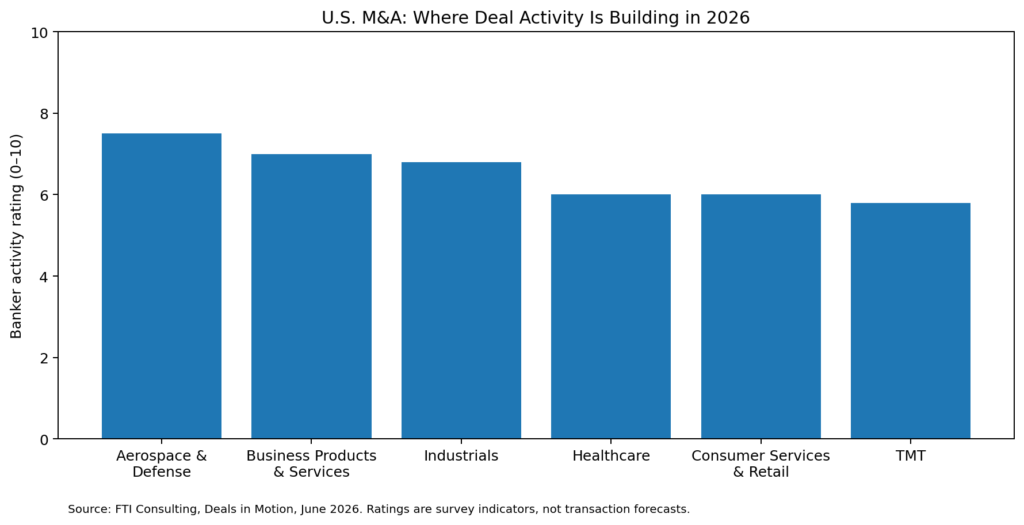
Investment bankers surveyed by FTI Consulting reported a meaningful improvement in M&A sentiment in 2026, with aerospace and defense, business products and services, and industrials among the strongest areas. FTI said bankers are also seeing improved access to financing and greater pressure from investors to deploy capital that has been sitting on the sidelines. (FTI Consulting)
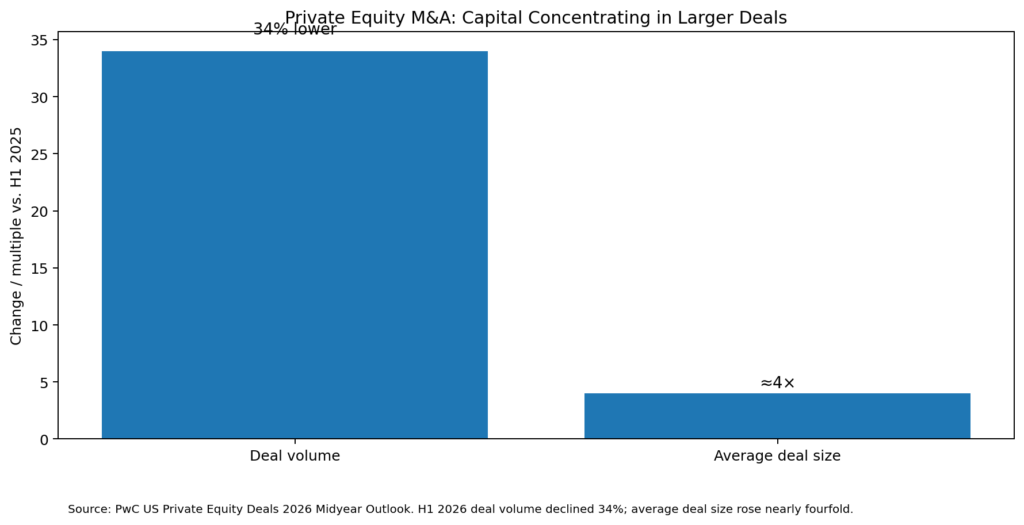
At the same time, private equity is becoming more selective. PwC reported that U.S. private-equity deal volume declined 34% in the first half of 2026, while average deal size rose nearly fourfold compared with the first half of 2025. In other words, capital is concentrating around transactions that buyers consider particularly compelling. (PwC)
That distinction could become one of the defining characteristics of the current M&A cycle.
The New M&A Rule: Quality Over Quantity
During easier money periods, buyers can afford to take chances. When financing becomes more expensive or economic uncertainty increases, the quality of the underlying business becomes much more important.
Today’s buyer is increasingly asking several questions:
- Does the company generate consistent cash flow?
- Does it have recurring customers?
- Can it operate without the owner?
- Does it have pricing power?
- Is its workforce difficult to replace?
- Does it possess specialized intellectual property?
- Can artificial intelligence improve the business rather than eliminate it?
- Does the company have a defensible geographic or technical niche?
Those questions are changing valuations.
A business that can demonstrate dependable demand, strong margins and limited exposure to technological disruption may attract multiple buyers even when a comparable company is struggling to find interest.
This is where the concept of an AI-resilient business is becoming increasingly important.
Why AI-Resilient Businesses May Command a Premium
Artificial intelligence is forcing buyers to reconsider what constitutes a durable business.
A software company whose primary product can be replicated by increasingly capable AI systems may face a very different valuation discussion from a company that repairs industrial equipment, manufactures specialized components or provides essential field services.
That does not mean traditional businesses are immune to AI.
Quite the opposite.
A successful industrial company may use AI for scheduling, quoting, purchasing, predictive maintenance, customer service and inventory management. But the physical work still requires equipment, technicians, facilities and relationships.
That combination—technology-enhanced operations plus difficult-to-replace human expertise—is becoming attractive to acquirers.
The same logic applies to healthcare services. PwC says healthcare dealmakers are prioritizing scalable, cash-generating platforms with clearer reimbursement visibility, while strategic buyers and private equity firms continue using bolt-on acquisitions and carve-outs to build larger platforms. (PwC)
J.P. Morgan likewise describes healthcare M&A as active, with capital pursuing differentiated innovation, scalable platforms, resilient business models and AI-related opportunities. (JPMorgan Chase)
Industrials Are Back on the M&A Radar

Industrial businesses are particularly interesting because many contain characteristics that buyers increasingly value.
A well-run machine shop, electric motor repair operation, industrial maintenance company, specialty manufacturer or equipment service company may possess:
- Long-term customers
- Specialized technical knowledge
- Expensive equipment
- Established vendor relationships
- Experienced employees
- High barriers to entry
- Repeat repair or maintenance demand
FTI’s 2026 survey put industrials at a 6.8 current-activity rating, up significantly from 5.2 in its 2025 comparison. Bankers specifically cited domestic manufacturing positioning, private-equity-backed processes and carve-outs as important areas of activity. (FTI Consulting)
That creates an interesting environment for owners approaching retirement.
A specialized manufacturer with a strong customer base could be considerably more valuable to a strategic buyer than its owner realizes—particularly if the buyer can add sales, technology, purchasing power or geographic reach.
For example, Machine Shop Business Brokers are increasingly dealing with buyers interested not simply in the equipment, but in the customer relationships, workforce and specialized knowledge surrounding that equipment.
The Baby Boomer Retirement Effect
Perhaps the biggest structural force behind the next wave of private-company transactions has nothing to do with Wall Street.
It is retirement.
Millions of American business owners who started companies decades ago are approaching or entering retirement. Many built successful businesses without ever creating a formal succession plan.
For those owners, an acquisition can provide a way to convert decades of work into retirement capital while giving the company an opportunity to continue operating.
This is particularly relevant in trades and industrial services.
Consider a 30-year-old generator repair business, electrical contractor, machine shop or specialty repair company. The owner may have built the business around personal relationships and decades of technical expertise.
The challenge is that the owner cannot simply retire and expect those relationships and skills to transfer automatically.
That is where M&A professionals become increasingly important.
The Succession Problem Is Bigger Than Finding a Buyer
Selling a business is not merely a transaction.
It is a transition.
The buyer needs to understand the financial statements, customer concentration, equipment condition, employee structure, leases, intellectual property, contracts, insurance, environmental issues and working-capital requirements.
The seller needs to understand valuation, taxes, financing, representations and warranties, transaction structure and what happens after closing.
Then comes the human element.
Who introduces the new owner to major customers?
Who trains employees?
Who explains the company’s unwritten procedures?
Who knows which supplier can solve an emergency problem at 2 a.m.?
For many retiring owners, these questions can be more important than the headline purchase price.
The Retirement Advisor Will Become Part of the M&A Team
The coming generation of business transfers will require more cooperation between investment bankers, business brokers, CPAs, attorneys and retirement professionals.
A business owner may have spent 30 years accumulating wealth primarily inside the company.
That creates a major financial planning question:
What happens after the business is sold?
A retirement advisor can help the owner evaluate how transaction proceeds fit into a broader retirement strategy, including cash reserves, investment income, tax planning and long-term spending needs.
The advisor may also help determine whether the owner should accept an all-cash transaction, seller financing, an earn-out or another structure.
This is why a good retirement planner can become an important member of the transaction team—not because the planner sells the business, but because the business may represent the owner’s largest financial asset.
Regional M&A: Where the Action Is
The M&A recovery is not evenly distributed geographically.
Texas and the Southeast
Texas, Florida, Georgia, North Carolina and other southeastern markets continue to attract companies seeking population growth, industrial expansion, lower operating costs and business-friendly environments.
Manufacturing, logistics, healthcare, construction services and industrial services are particularly interesting.
Northeast
Pennsylvania, New York and New Jersey remain important because of their concentration of established privately owned companies.
The Northeast has an enormous base of older industrial businesses, specialty manufacturers, repair companies and service providers.
That makes the region fertile territory for succession transactions.
Midwest
Michigan, Ohio, Indiana, Illinois and Wisconsin remain particularly important for manufacturing-related transactions.
Companies supporting automotive, aerospace, industrial machinery, electrical equipment and precision manufacturing can attract both strategic and financial buyers.
Specialized labor is also valuable. In many industrial businesses, electric motor winders are hard to find, making an established repair operation with experienced employees potentially more attractive than a company with similar revenue but a less specialized workforce.
Mountain West and Southwest
Arizona, Colorado, Nevada and parts of the Southwest are seeing continued interest in technology, aerospace, defense, energy and specialized services.
The regional picture is therefore becoming increasingly diverse: buyers are not necessarily looking for Silicon Valley technology companies. Many are looking for profitable businesses that solve essential problems.
Small Businesses Are Becoming M&A Targets
Another important change is the increasing sophistication of the lower-middle market.
A business does not need $100 million in annual revenue to attract an acquisition-minded buyer.
A profitable company with $300K, $1 million, $5 million or $10 million in revenue can potentially attract strategic buyers, private investors, search funds and individual entrepreneurs.
This includes specialty companies such as an RV Onan generator repair shop for sale, provided the business has attractive fundamentals, defensible customer relationships and transferable operations.
The same logic applies to an electrician for sale or an electronics repair business for sale. Buyers may see opportunities to combine several smaller operations, expand service territories and create larger regional platforms.
The Skilled-Labor Premium
One of the less obvious M&A trends is the value of human expertise.
AI can analyze data, draft documents and automate administrative tasks. It cannot easily replace a veteran technician who can diagnose a 40-year-old industrial motor by sound, rebuild a specialized gearbox or repair equipment in a remote facility.
That expertise has economic value.
Businesses with experienced technicians can therefore become attractive acquisition targets because the buyer is purchasing not just revenue, but a workforce that may be extremely difficult to recreate.
The same consideration applies to specialty finishing and manufacturing. Investors examining industrial painter salary outlook and other skilled-trade compensation trends are also evaluating whether companies can recruit and retain the people required to deliver their services.
Financing Remains a Wild Card
The M&A market is improving, but financing is not uniformly easy.
The Federal Reserve reported in its July 2026 Monetary Policy Report that financing conditions for large companies remained generally accommodative, while small-business financing conditions remained somewhat restrictive. (Federal Reserve)
That distinction matters.
A large corporation may have access to public debt markets that a $5 million industrial company does not.
Consequently, smaller transactions may require a combination of bank financing, seller financing, private credit, buyer equity and other structures.
Dealmakers who understand these financing alternatives may have an advantage.
What Buyers Will Pay a Premium For
The strongest businesses entering the market are likely to share several characteristics:
Recurring revenue.
Predictable income makes financing easier and reduces buyer risk.
Low customer concentration.
A company dependent on one customer can receive a valuation discount.
Strong management.
Businesses that depend entirely on the retiring owner are harder to transfer.
Specialized labor.
Hard-to-replace technical skills can create a competitive moat.
Modern financial records.
Clean books make due diligence easier.
Technology adoption.
AI, automation and modern enterprise software can improve productivity.
Defensible demand.
Essential repairs, healthcare services, infrastructure and specialty manufacturing may be more resistant to economic swings.
Growth opportunities.
Buyers want to see what they can improve after closing.
The Business Broker’s Changing Role
The traditional image of a business broker was once largely associated with putting a company on the market and finding buyers.
That role is becoming considerably more sophisticated.
Today, a top business broker may need to understand valuation, financing, quality-of-earnings analysis, buyer psychology, tax considerations, succession planning and industry-specific risks.
For larger transactions, investment banks may lead the process, while middle-market business brokers and M&A advisors handle smaller transactions.
The best advisers increasingly function as project managers for the entire transaction.
That matters because a failed transaction can be expensive for everyone.
A seller can spend months preparing a business for sale only to discover that the financial records are inadequate, the valuation is unrealistic or the buyer cannot obtain financing.
Preparation therefore becomes a competitive advantage.
A New Kind of American Wealth Transfer
The next decade could represent one of the largest ownership transitions in American private business.
The headline may say “M&A recovery,” but underneath that headline is something much more personal: thousands of business owners asking what happens to the company they spent their careers building.
Some businesses will be sold to competitors.
Others will be purchased by private-equity-backed platforms.
Some will be transferred to children.
Others will be purchased by first-time entrepreneurs.
And some will disappear because they were never prepared for a transition.
That makes succession planning increasingly important.
The opportunity extends beyond finance. Lawyers, accountants, retirement advisors, lenders, valuation specialists, business brokers and investment bankers will all have roles to play.
The Outlook
The 2026 M&A market is not a return to indiscriminate dealmaking. It is becoming a market where quality commands attention.
FTI’s banker survey points to improving sentiment across most sectors, particularly industrials, business services and aerospace and defense. (FTI Consulting) Meanwhile, PwC’s data show that private equity is concentrating capital into larger, higher-conviction transactions rather than simply pursuing volume. (PwC)
For owners, the message is straightforward: waiting until retirement to prepare a company for sale may be too late.
For buyers, the opportunity may be in businesses that have been overlooked because they are not glamorous—but possess customers, cash flow, specialized employees and essential products or services.
And for advisors, the coming ownership transition could create a decade of work.
Even seemingly unrelated searches—from cheap travel deals to investor conferences to premium keyword domains for sale—reflect the broader entrepreneurial economy surrounding dealmaking. But the core opportunity remains much simpler: finding good businesses, preparing them properly and matching them with buyers capable of taking them into their next chapter.
The next M&A cycle may therefore be less about financial engineering and more about industrial knowledge, succession and durability.
That could make the coming years particularly interesting for owners of the kinds of privately held American businesses that have quietly powered the economy for generations.
Editorial note: This article is for general informational purposes and is not investment, legal, tax or financial advice. M&A conditions, valuations and financing availability can change quickly. Business owners considering a transaction should consult appropriately qualified legal, tax, accounting, financial and M&A professionals.