Love, peace, courtship, agriculture, and politics in poetry that survived the ages
FEATURE ARTICLE · ANCIENT LITERATURE · WORLD HISTORY
Between 200 and 600 AD, the ancient world was undergoing profound changes. The Roman Empire was transforming, Christianity was spreading, classical Greek and Roman culture continued to influence intellectual life, and literary traditions in India and China were flourishing in distinctive ways.
Poets wrote about love and longing, the beauty of the natural world, the dignity of rural life, political power, morality, and the search for peace. Some poems survived because of their extraordinary beauty. Others endured because they expressed emotions that people across generations could understand. Still others were preserved by scholars, religious institutions, and imperial courts.
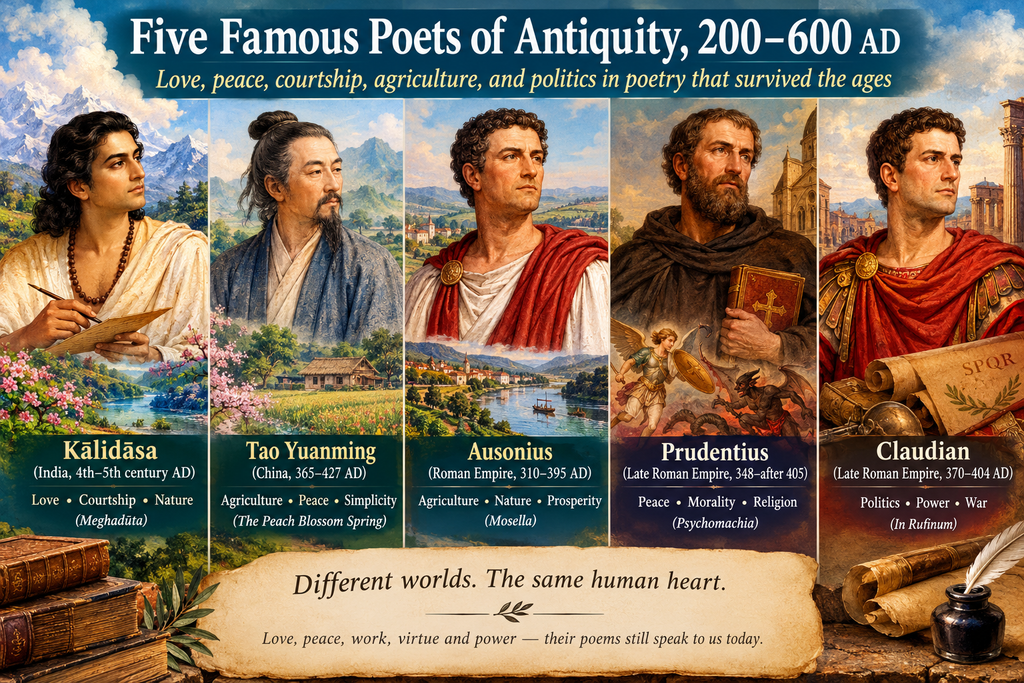
The five writers featured here offer a fascinating glimpse into the literary world of late antiquity.
One important distinction: not every poet from this period is known for a single, universally accepted “most famous poem.” In some cases, a collection or a prose narrative is better known than an individual lyric.
1. Kālidāsa — India, approximately 4th–5th century AD

CIVILIZATION: CLASSICAL INDIA · LANGUAGE: SANSKRIT
Themes: Love, courtship, nature, separation
Kālidāsa is widely regarded as one of the greatest poets and dramatists in Sanskrit literature. Although the exact dates of his life remain uncertain, many scholars associate him with the Gupta period, an era celebrated for remarkable artistic and intellectual achievements.
His surviving works include plays, epic poetry, and lyrical compositions. He was especially gifted at making the natural world reflect the emotional lives of his characters.
Most famous poem: Meghadūta (The Cloud Messenger)

In Meghadūta, an exiled celestial being known as a yaksha is separated from his beloved wife. When the monsoon season arrives, he asks a passing cloud to carry a message to her.
The poem follows the cloud’s imagined journey across mountains, rivers, forests, cities, and sacred places. As the cloud travels, the yaksha describes the landscapes it will encounter and imagines the emotions his message will awaken in his absent beloved.
The cloud becomes much more than a weather phenomenon. It is a messenger of devotion, hope, and the possibility of reunion.
Why was it loved, and why has it survived?
Kālidāsa understood that love can become especially intense when the beloved is absent. His poem captures the ache of separation and the imagination of courtship, transforming distance into a landscape filled with memories and expectations.
Nature plays an essential role. Rivers, mountains, rain, and flowering landscapes seem to participate in the lover’s yearning.
The work inspired later messenger poems in Sanskrit and other literary traditions. Its central idea remains familiar today: people separated from those they love still rely on letters, photographs, songs, and imagined journeys to bridge the distance.
Central theme: Love can survive distance, and nature can give expression to feelings that ordinary words cannot fully convey.
2. Tao Yuanming — China, 365–427 AD

CIVILIZATION: CHINA · LANGUAGE: CLASSICAL CHINESE
Themes: Agriculture, peace, simplicity, political disillusionment
Tao Yuanming, also known as Tao Qian, lived during the Eastern Jin and early Liu Song dynasties. He briefly held government positions but eventually became dissatisfied with the demands and compromises of official life.
He withdrew to the countryside, where he farmed, wrote poetry, welcomed friends, and reflected on the value of a simpler existence. His work helped establish the Chinese pastoral tradition, in which rural life became a source of independence and spiritual satisfaction.
Most famous work: The Peach Blossom Spring

Although The Peach Blossom Spring is a prose tale rather than a poem, it is Tao Yuanming’s most famous literary work.
The story describes a fisherman who discovers a hidden valley beyond a grove of peach trees. Inside, he finds an isolated community whose inhabitants live peacefully, seemingly untouched by the political upheavals and conflicts of the outside world.
The people cultivate the land, maintain stable families, and enjoy a harmonious existence. When the fisherman eventually returns to the outside world, he cannot find the secret valley again.
Tao’s related poems, particularly Returning to Dwell in the Country, explore the pleasures and hardships of agricultural life and the freedom that comes from abandoning an unwanted official career.
Why was it loved, and why has it survived?
Tao offered an alternative to the relentless pursuit of wealth, rank, and political influence. His ideal community represented peace not as a military victory, but as a way of life free from greed, exploitation, and unnecessary conflict.
His farming imagery also gave dignity to ordinary work. The countryside was not merely a refuge for the wealthy; it was a place where people cultivated food, sustained relationships, and learned to accept life’s limitations.
Later Chinese poets admired his simplicity and independence. His secluded paradise became a lasting cultural symbol, inspiring literature, painting, garden design, and reflections on what a peaceful society might look like.
Central theme: A meaningful life may be found in honest work, nature, and freedom from corrupt ambition.
3. Decimus Magnus Ausonius — Roman Empire, approximately 310–395 AD

CIVILIZATION: LATE ROMAN EMPIRE · LANGUAGE: LATIN
Themes: Agriculture, nature, rural prosperity, imperial life
Ausonius was a Roman poet, teacher, and public official born in Burdigala, modern-day Bordeaux, in Gaul. His education and command of rhetoric brought him professional success, and he eventually became tutor to the future emperor Gratian.
His career took him into the world of imperial politics, but his poetry also demonstrated a keen appreciation for rivers, cultivated landscapes, vineyards, and the countryside of the western Roman Empire.
Most famous poem: Mosella (The Moselle)
Ausonius describes clear waters, fish beneath the surface, wooded banks, vineyards, country houses, and hills reflected in the river. His descriptions transform a particular region into a landscape of abundance and beauty.
The poem is more than a travel description. It reveals how river life, agriculture, leisure, and human settlement can form a harmonious whole.
Why was it loved, and why has it survived?
Mosella offers a vivid picture of the countryside during a period when the Roman world faced significant political and military changes. Its vineyards and productive land evoke prosperity, while the flowing river suggests continuity amid uncertainty.
Unlike heroic epics that concentrate on battles and conquest, Ausonius finds grandeur in a river and the ordinary life surrounding it.
His detailed descriptions also remind modern readers that agriculture was never merely an economic activity. Fields, vineyards, rivers, and settlements shaped regional identity and supported the foundations of Roman society.
The poem preserves the literary techniques of classical Rome while demonstrating that the natural world could be worthy of sustained poetic attention in its own right.
Central theme: The beauty of a cultivated landscape can unite nature, human labor, and civilization.
4. Aurelius Prudentius Clemens — 348–after 405 AD

CIVILIZATION: LATE ROMAN EMPIRE · LANGUAGE: LATIN
Themes: Peace, morality, religion, cultural change
Prudentius was a Christian poet born in the Roman province of Tarraconensis, in what is now Spain. He received a traditional classical education and pursued a career in public administration before devoting himself to religious poetry.
His writing combined Christian beliefs with the sophisticated language, poetic meters, and literary forms inherited from earlier Roman authors. His works became particularly influential in medieval Christian Europe.
Most famous poem: Psychomachia (The Battle of the Soul)
The battles symbolize the moral conflicts taking place within the human soul. Drawing on the dramatic imagery of classical epic, Prudentius turns abstract ethical ideas into memorable characters and confrontations.
The work is not simply concerned with victory over an external enemy. Its central subject is spiritual transformation and the challenge of building a virtuous life.
Why was it loved, and why has it survived?
Prudentius gave physical form to difficult moral concepts. Readers could imagine Pride as a warrior or Patience as a courageous defender, making ethical ideas easier to remember, teach, and illustrate.
The poem had a lasting impact on medieval literature and art. Its allegorical approach helped establish a tradition in which virtues and vices became characters in moral dramas.
Its treatment of peace is especially compelling. Peace requires more than the absence of war; it also demands restraint, justice, self-discipline, and resistance to destructive impulses.
The work reflects the transformation of Roman literary culture as Christianity became increasingly influential, while preserving much of the formal power of classical poetry.
Central theme: Lasting peace begins with the struggle to overcome greed, pride, and cruelty within ourselves.
5. Claudian — approximately 370–404 AD

CIVILIZATION: LATE ROMAN EMPIRE · LANGUAGE: LATIN
Themes: Politics, power, war, leadership, public reputation
Claudian was a poet of Greek origin who became prominent in the Latin literary world of the Western Roman Empire during the 390s. Born in Alexandria, he established himself in Rome and became closely associated with the imperial court, particularly the powerful general Stilicho and Emperor Honorius.
His career depended partly on his ability to celebrate political leaders, commemorate public events, and attack their rivals. He became one of the most significant political poets of late antiquity.
Most famous political poem: In Rufinum (Against Rufinus)
Claudian portrays Rufinus as a destructive and corrupt figure whose ambition threatens the state. Through elevated epic language and dramatic imagery, he transforms a contemporary political struggle into a conflict between wrongdoing and justice.
Claudian also wrote celebrations of emperors and military commanders. His work therefore reveals two sides of political poetry: the denunciation of alleged corruption and the praise of those claiming to defend the state.

Why was it loved, and why has it survived?
Claudian offered audiences an exciting, highly literary interpretation of contemporary events. Rather than simply reporting political rivalries, he presented them as epic struggles in which the future of the empire appeared to be at stake.
His work demonstrates how poetry could serve as political communication. Rulers and their supporters used poets to strengthen reputations, justify policies, condemn opponents, and influence public opinion.
Modern readers should remember that court poetry is not neutral history. Claudian’s descriptions of his enemies reveal political persuasion as much as they reveal the people being attacked.
Yet this is precisely what makes his writing valuable. It shows how imperial leaders sought legitimacy and how literary talent could become an instrument of political power.
Central theme: Poetry can preserve political struggles while also shaping the reputations through which history remembers them.
Why these poems survived the ages

The five writers represent different answers to a common human question: what makes life worth living?
- Love and courtship: Kālidāsa showed how longing can turn a cloud, a landscape, and an imagined journey into expressions of devotion.
- Agriculture and peace: Tao Yuanming celebrated a fulfilling life rooted in the land, while Ausonius made a cultivated river valley worthy of epic attention.
- Moral peace: Prudentius transformed the struggle between vice and virtue into a memorable allegory that generations could interpret and illustrate.
- Politics and power: Claudian demonstrated how poetry could preserve political conflicts while actively participating in them.
These works endured for several reasons. Their authors possessed considerable technical skill; their writings were copied, studied, translated, and taught; and their themes remained relevant as societies changed.
Religious institutions helped preserve Prudentius. Chinese literary traditions sustained the reputation of Tao Yuanming, while generations of Sanskrit scholars and poets transmitted Kālidāsa’s works. Classical education kept Latin poets such as Ausonius and Claudian in circulation.
Their survival also illustrates the importance of cultural institutions. A poem must be appreciated, but it must also be transmitted. Manuscripts, schools, libraries, commentaries, and translations helped carry these works across centuries.
Most importantly, these writings do not speak only about the societies that produced them. They speak about missing someone, tending the land, seeking refuge from conflict, choosing a moral path, and confronting political ambition.

The clothing, political systems, and religious beliefs of antiquity may seem distant from modern life, but the human emotions beneath the poetry remain remarkably familiar.
Their lasting achievement is their ability to make the concerns of people who lived more than a thousand years ago recognizable to readers today.