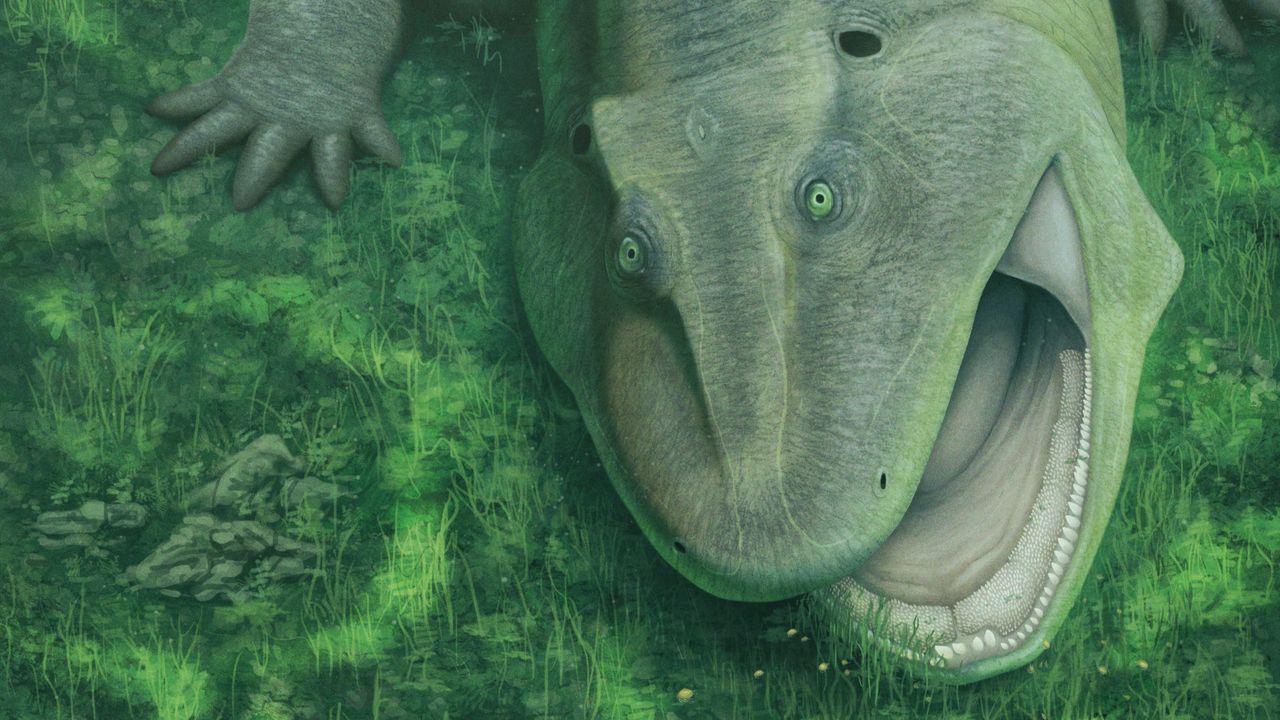
Paleontologists have revealed a bizarre prehistoric creature with a twisted jaw and sideways-facing teeth, and the water-dwelling weirdo was already a “living fossil” when it existed 275 million years ago.
The newly described species, named Tanyka amnicola, is an archaic member of the tetrapods — a large group of four-limbed vertebrates that today includes reptiles, birds, mammals and amphibians, according to a study published Wednesday (March 4) in the journal Proceedings of the Royal Society B.
“Tanyka is from an ancient lineage that we didn’t know survived to this time, and it’s also just a really strange animal,” lead study author Jason Pardo, a research associate at the Field Museum in Chicago, said in a statement. “In the sense that Tanyka was a remaining member of the stem tetrapod lineage, even after newer, more modern tetrapods evolved, Tanyka is a little like a platypus. It was a living fossil in its time.”
Researchers identified the new species from nine fossilized lower jawbones, each roughly 6 inches (15 centimeters) long, recovered from a dry riverbed in northeastern Brazil. Although the creature’s lower jawbones were distinctive enough for the team to determine the fossils represented a new species, the lack of other fossilized remains means much about the animal remains unknown.
So it’s not a deformation, it’s just the way the animal was made.
Jason Pardo, Field Museum research associate
Given what is known about its close relatives, however, T. amnicola might have resembled a salamander with a slightly longer snout. It possibly measured up to around 3 feet (around 91 centimeters) in length, Pardo said. The type of rocks in which the fossils were found also indicate that the creature lived in lake environments and presumably had “aquatic habits,” according to the paper.
Analysis of the lower jawbones revealed some intriguing features — principally, that they were twisted so that the creature’s teeth pointed outward to the sides, rather than upward as seen in virtually all other tetrapods.
“The jaw has this weird twist that drove us crazy trying to figure it out,” Pardo said. “We were scratching our heads over this for years, wondering if it was some kind of deformation. But at this point, we’ve got nine jaws from this animal, and they all have this twist, including the really, really well-preserved ones. So it’s not a deformation, it’s just the way the animal was made.”
Furthermore, the inner surface of the lower jawbone, which faces the tongue in humans, was rotated upward; it was covered in a “remarkable” set of small, teeth-like structures called denticles that would have formed a grinding surface, according to the study. These features suggest the animal had a “relatively unique way” of feeding, Pardo said.
The authors suspect that T. amnicola was adapted to munching on small invertebrates or, potentially, some plant material. This would be unusual, given the lack of evidence for plant-eating or omnivorous diets in other stem tetrapods, which are thought to have been carnivores, the team said.
When T. amnicola lived, Brazil was part of the supercontinent Gondwana. According to the statement, the discovery provides a window into Gondwana’s animals during this period. “Tanyka is telling us about how this community actually worked, how it was structured, and who was eating what,” study co-author Ken Angielczyk, a curator of paleomammalogy at the Field Museum, said in the statement.
Pardo, J., Marsicano, C., Smith, R., Cisneros, J., Angielczyk, K., Fröbisch, J., Kammerer, C., & Richter, M. (2026). An aberrant stem tetrapod from the early Permian of Brazil. Proceedings of the Royal Society B. https://doi.org/10.1098/rspb.2025.2106
Published Date : 2026-03-04 00:05:00
Source : www.livescience.com