
Suppose that we go back to the time when there were no smartphones, no weather applications, no satellite pictures. Our ancestors relied on pure observation and instinct to know if a storm was coming, if the sun would shine, or if it was a good day at the lake. In the meteorology of the caveman, however, with the help of the models that we have owing to modern civilization, caveman weather forecasting is rather accurate, provided you know what to watch out. In this article, we’ll explore some ancient techniques, what they reveal, and how you can even try them today—perfect for figuring out when to go to the beach or plan outdoor adventures.
Seeing the Sky: Clouds, the Prophecies of Nature
Watching clouds was one of the most elementary methods our cavemen used to do. Cloud shapes, colors, movement, can tell much of what is going to happen in the future.
Puffy, white, clouds (cumulus) – Usually an indicator of fair weather. If these clouds appear in the morning, it might indicate a good day at the lake.
Thick, dark clouds (cumulonimbus) – May indicate that thunderstorms are about to come. When clouds suddenly darken, it is a sign that one has to seek shelter immediately.
Red skies at sunrise, sunset – The red sky at night, shepherd delight, The red sky in the morning, shepherd waning. When the sky turns red in the evening, the situation is likely to be stable, whereas when it turns red in the morning, there might be a threat of rain.
Looking at the sky daily gives you an exercise of using your senses so that you can see the minute changes as the old people did.
Reading Animal Behavior: Nature’s Barometer
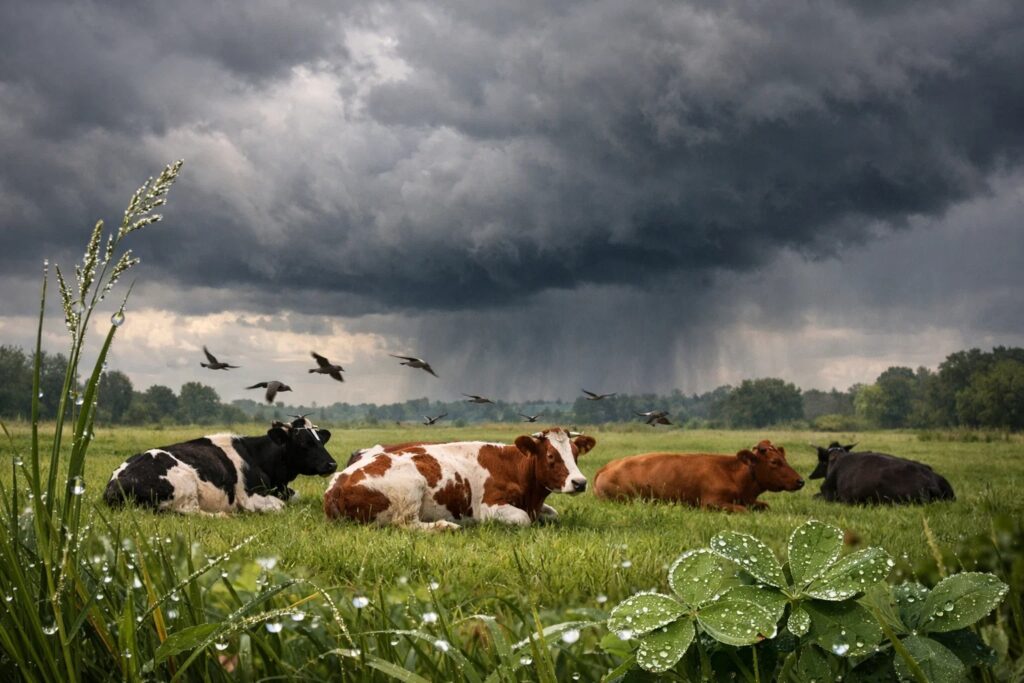
Animals are sixth sense in discerning the weather and seeing them was a major quality of cavemen.
Low-flying birds – Birds fly low before there is rain since the air pressure is reduced and the insects get nearer to the ground.
Cows lying down in the field – There are many people who believe that cows lying together down in the field are a sign that there is a storm in the offing. Scientists indicate that it might be associated with pressure or humidity.
Ants and insects – When it is raining heavily, ants usually close their hills or relocate further down the ground.
With their observation of wildlife, our ancestors could organize hunting, gathering, and travel it without any trouble.
The Touch of the Wind: Indicators of Ancient Air Pressure
Prior to the barometers, man knew how to read the wind. Direction and intensity of wind provide a timely forecast of the weather in advance.
Strong winds in unexpected directions – May signal the arrival of a storm front.
South wind warm weather – Could to-day bring rain or warmer weather.
Northern wind chillers – This is usually an indication of colder air coming in, which can be frost or snow, depending on the time of the year.
Cavemen used these observations together with other marks like the behaviour of the clouds and animal behaviour to predict more accurately.
Signals of Nature: Perfumes and Noises
Early weather observers have observed that weather variations can produce subtle influences on the environment.
Smell of the air – Sweet or earthy smell. The smell may be seen just before rain due to moisture, releasing some chemicals of soil and plants.
Thunder rumbling a long way – When thunder flies abnormally far, then there is a danger of a storm having developed some distance up-wind, and it will be signaled beforehand.
Frogs and crickets – Their song has been observed to vary with the temperature and humidity, indicating a foreboding of a change in weather.
The caveman weather forecasting was based on these natural sense signals.
Green Forecaster: Plant Behavior
Plants are also receptive to the changes in the atmosphere and ancient people knew how to interpret them.
Dew in the morning – A lot of dew is a sign of a sunny, clear day, and the lack of dew means that the day will be windy or rainy.
Flowers that close down at night or before a storm – There are numerous plants that close their petals when it is about to rain.
Behavior of trees and leaves – Sticky sap or hanging leaves may be the hidden signs of the changes in humidity or pressure in the air.
Our ancestors were able to predict the weather by observing plants and animals as well as the sky and this gave rise to a holistic weather prediction mechanism.
Extreme Weather: Signs to Predict Weather
Cavemen did not simply desire to know whether or not it would rain but they had to endure extreme weather. They used various observations to predict storms, floods or heat waves.
Dark and gusty wind, and animal disturbance – Probable storm or thunderstorm.
Continuous heat and stuffy air, as well as dry ground – May indicate that there may be drought or a heatwave in the near future.
Abnormal silence of birds + insects concealed + red sunrise – Rain or storm in hours.
With such combined indicators, they were able to plan the daily activities in a safe and efficient way.
Caveman Techniques in the Modern World
Still, in the modern world, these archaic ways may be surprisingly useful, when technologies fail, or you just want to be in touch with nature.
Beach trips – Observing morning clouds, animal behavior, and wind patterns can help decide when to go to the beach.
Fishing or lake trips – Birds and insect activity can signal the best time for catching fish or enjoying a good day at the lake.
Camping or hiking – It is possible to realize an abrupt shift in the wind or shape of the clouds and prevent hazardous storms.
The combination of these ancient methods with the use of modern weather applications gives you science and ancient wisdom.
Advantages and Limitations
Advantages:
- Does not need any tools or equipment.
- Promotes unity with nature.
- Is quite local and short-term predictions.
Limitations:
- Inaccurate at long term forecasting.
- Takes time and focuses on body language.
- Climatic variations cause may to vary regionally.
Conclusion
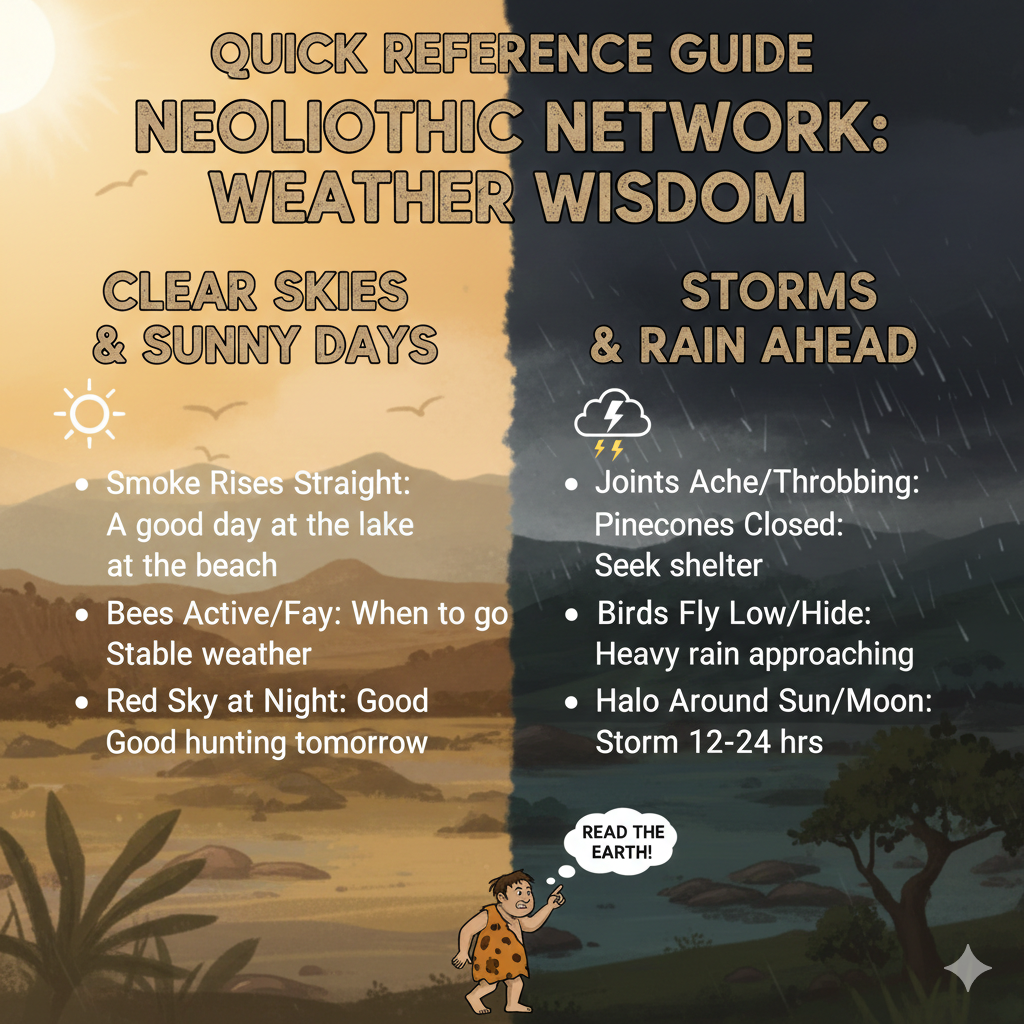
The Caveman-style weather forecasting reminds us that nature as such offers the means of predicting the weather. With the help of the observation of clouds, animals, wind, plants, and even smells, the ancient people were able to navigate day-to-day life in a safe and proficient way. While we now have satellites and weather models, these simple techniques can enhance your outdoor experiences and even guide you on when to go to the beach or plan a good day at the lake. Listening to nature does not only provide us with information on weather but it also makes us more attached to the planet we inhabit.