How Japan Post, Deutsche Post, Saudi Aramco, Singtel and other government-backed enterprises became publicly traded giants
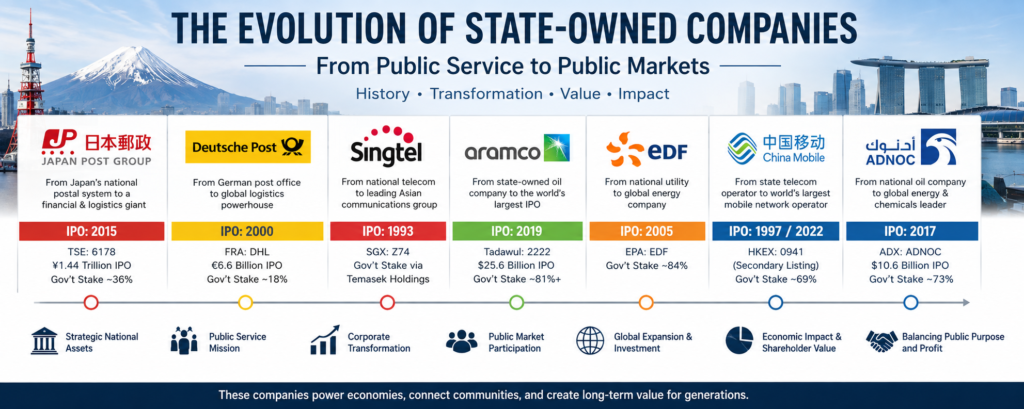
For much of modern economic history, some of the world’s largest and most strategically important companies were not designed to answer to ordinary shareholders. They were created, owned or controlled by governments.
Postal systems, telecommunications networks, energy companies, railroads, airlines, banks and utilities were often considered too important to leave entirely to private enterprise. Governments wanted to guarantee national service, protect strategic industries, create employment and maintain control over infrastructure that could affect national security.
But beginning particularly in the 1980s and accelerating through the 1990s and 2000s, a major transformation began. Governments started corporatizing, restructuring and eventually selling portions of these enterprises to the public.
The result was a new breed of company: the publicly traded state-influenced corporation.
These companies could have millions of shareholders while governments continued to own substantial stakes. Some became enormous investment stories. Others struggled with bureaucracy, political interference or changing technology. A few became global acquisition machines.
Japan Post is one of the most interesting examples.
Japan Post: From Government Service to Tokyo Stock Exchange Company
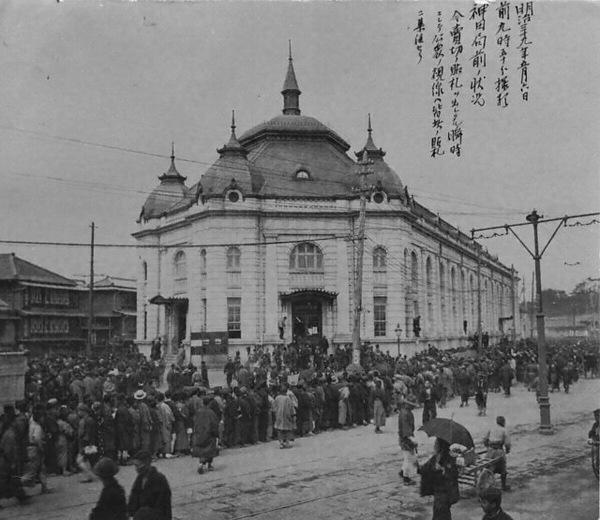
Japan’s postal system was historically much more than a place to buy stamps. It became deeply integrated with the country’s financial system through postal savings and insurance.
The modern Japan Post Group structure was established during Japan’s postal privatization process. Japan Post Holdings and its financial subsidiaries Japan Post Bank and Japan Post Insurance eventually became publicly traded companies.
The landmark event came in 2015, when the government simultaneously brought three Japan Post companies to the public market.
Japan Post Holdings trades on the Tokyo Stock Exchange under code 6178. Japan Post Bank and Japan Post Insurance were also listed. The government planned the transaction as part of the broader privatization effort, while also raising money for government priorities including reconstruction following the 2011 earthquake and tsunami.
The scale was enormous. The combined offering of the three companies raised approximately ¥1.44 trillion, making it one of the world’s largest IPO transactions of its era. Japan Post Holdings shares were priced at ¥1,400 per share in the initial offering. (The Japan Times)
The government continued selling shares after the IPO. The 2017 offering alone involved approximately 990 million Japan Post Holdings shares. (Japan Post)
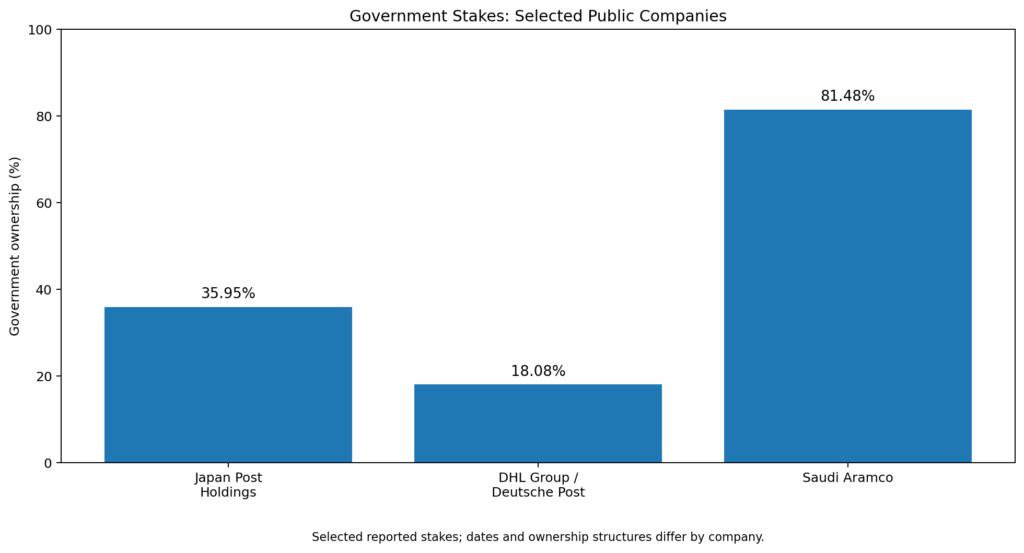
Japan Post is still far from being an ordinary private corporation. As of March 31, 2026, government and local public bodies collectively accounted for approximately 35.95% of Japan Post Holdings’ shares, according to the company’s shareholder statistics. The Japanese Finance Minister was listed as the largest shareholder with approximately 38.05% in the company’s detailed shareholder table, reflecting differences between shareholder classifications and treasury-share calculations. (Japan Post)
The company remains massive in physical reach. Japan Post reported more than 24,000 post offices and approximately 169,000 employees for Japan Post Co. as of 2026. (郵便局 | 日本郵便株式会社)
That makes Japan Post a fascinating hybrid: part commercial corporation, part national infrastructure.
Deutsche Post: When the Post Office Became a Global Logistics Company
Germany followed a different but equally dramatic path.
Deutsche Post was transformed from a government postal administration into a commercial corporation and eventually into one of the world’s largest logistics companies.
The company’s IPO took place in November 2000. Germany’s government and KfW sold roughly 29% of Deutsche Post’s share capital, generating approximately €6.6 billion in proceeds. (Bundesministerium der Finanzen)
The really important part came afterward.
Deutsche Post did not simply remain a European postal operator. It pursued international expansion and acquired major logistics businesses, most famously DHL. The combination helped transform the company from a national postal service into a global parcel, freight, express and supply-chain company.
The company’s shares trade on the Frankfurt Stock Exchange, with trading through Deutsche Börse’s Xetra system under the symbol DHL. (DHL Group)
The German government has continued to maintain an important financial connection. As of June 30, 2026, KfW held approximately 17.727% of the company, while the German federal government held approximately 18.08% when holdings through KfW and other structures were included. (DHL Group)
The company is now moving into another chapter. Shareholders approved a restructuring in 2026 under which the listed parent is scheduled to operate under the name DHL AG, while Post & Parcel Germany will become a separate unlisted subsidiary. (DHL Group)
That evolution illustrates one of the great lessons of privatization: the government’s old postal company can eventually become something much larger and commercially different.
Singtel: Singapore’s Telecom Revolution
Singapore Telecommunications, better known as Singtel, offers another model.
The company emerged from the restructuring of Singapore’s telecommunications authority. Singtel was corporatized in 1992 in preparation for public listing and increased competition.
In 1993, Singtel launched what was then Singapore’s largest IPO. Shares began trading on the Singapore Stock Exchange on November 1, 1993. The government intentionally offered shares at a discount as part of a policy designed to broaden Singaporean share ownership. (Singtel)
Unlike a simple domestic utility, Singtel rapidly became an international telecommunications player.
It acquired interests in companies including Globe in the Philippines, AIS in Thailand, and later expanded its regional technology and telecommunications operations. Singtel also acquired National Computer Systems, strengthening its enterprise technology capabilities. (Singtel)
The company is listed on the Singapore Exchange, and it has also had a secondary listing history in Australia.
Today, Singtel demonstrates another version of government influence. It is publicly traded but remains strongly associated with Singapore’s state investment system through Temasek Holdings.
In 2026, the company was also completing the transfer of its special discounted shares scheme, originally created in 1993 to encourage Singaporeans to participate in the country’s economic growth. Singtel said approximately 615,000 shareholders were involved in the transfer process. (Singtel)
The original government strategy therefore went beyond simply raising money. It was also about creating a population of shareholders.
Saudi Aramco: The Billion-Dollar IPO That Rewrote the Record Books
Few state-owned companies have attracted as much attention as Saudi Aramco.
The oil company traces its origins to the development of Saudi Arabia’s petroleum industry during the 20th century and eventually became the country’s dominant energy enterprise.
For decades, the company was entirely state controlled.
That changed dramatically in 2019.
Saudi Arabia listed Aramco on the Saudi Exchange, commonly known as Tadawul, under symbol 2222. The IPO sold approximately 1.5% of the company’s shares and raised $25.6 billion, setting a record for the world’s largest IPO at the time. (Saudi Press Agency)
The shares were priced at 32 Saudi riyals, producing an initial valuation of approximately $1.7 trillion. The company briefly reached approximately $2 trillion in market capitalization after its debut. (Tadawul Annual Report 2019)
The transaction was about much more than stock-market bragging rights.
Saudi Arabia’s leadership viewed the sale as part of Vision 2030, an effort to diversify the kingdom’s economy and generate capital for investments outside traditional oil production.
The government subsequently conducted additional transactions involving Aramco shares. In 2024, for example, the government sold another approximately 1.7 billion shares, representing about 0.7% of the company’s issued shares. Aramco’s reported ownership structure still showed the Saudi government with 81.48% direct ownership at the end of 2024. (Aramco)
As of 2026, Aramco’s own investor information continues to identify the Saudi government as holding more than 81.48% of the company. (Aramco)
The Aramco story also demonstrates why government-controlled public companies can be unusual investments. Shareholders can participate in the economics of a giant corporation, but the government retains overwhelming influence.
Why Governments Sell Stakes in the First Place
There are several reasons governments pursue these transactions.
First is capital. Selling shares can produce billions of dollars without immediately selling an entire national asset.
Second is market discipline. Public companies must publish financial information, report to shareholders and operate under securities-market rules.
Third is efficiency. Corporatization can force an organization to think about profitability, productivity and capital allocation in ways that a traditional government department may not.
Fourth is citizen ownership. Japan and Singapore both used major offerings to encourage ordinary citizens to become shareholders.
Fifth is strategic recycling of capital. Governments can sell a minority interest and redirect the proceeds toward infrastructure, debt reduction, sovereign investment funds or other national priorities.
There is also a political dimension.
A government can retain control of a strategically important enterprise while allowing private investors to participate in its future.
That creates a balancing act.
What Investors Like — and Dislike
Investors often find these companies attractive because government backing can create stability.
A postal network is unlikely to disappear overnight. A national oil company may possess enormous reserves. A telecommunications operator can control valuable infrastructure. A logistics company may benefit from decades of established distribution networks.
But state influence can also create concerns.
Government objectives may not always match shareholder objectives.
A government might want a company to maintain employment, operate unprofitable routes or support national policy even when doing so does not maximize short-term shareholder returns.
That is why investors examining government stake stocks need to look beyond the headline share price.
Important questions include:
- Who controls the voting rights?
- Can the government veto major decisions?
- Is the company required to provide public services?
- How much debt does it carry?
- What percentage of shares are actually available for public trading?
- Is the government likely to sell additional shares?
- How independent is the board?
- Does the company have a commercial strategy separate from government policy?
The Big Deals That Changed Their Companies
The most interesting part of this history may not be the IPO itself.
It is what happened afterward.
Deutsche Post’s acquisition and integration of DHL helped transform a national postal enterprise into a global logistics company. Singtel used acquisitions and strategic investments to become a regional telecommunications operator rather than simply a Singaporean telephone company. Saudi Arabia’s partial Aramco listing converted a previously closed national champion into a publicly scrutinized corporation while creating capital for the kingdom’s broader investment strategy.
Japan Post’s structure is different again because its enormous postal network remains intertwined with banking, insurance, logistics and public-service responsibilities.
These transactions show that privatization does not necessarily mean “government disappears.”
Often it means government ownership changes form.
The Modern State-Owned Public Company
The 21st-century version of a state-owned enterprise can be surprisingly sophisticated.
Some operate multinational subsidiaries. Some issue bonds internationally. Some acquire foreign companies. Some pay substantial dividends. Some are included in major stock indexes.
And some continue to perform functions that private competitors cannot easily duplicate.
The public market adds another layer.
Once shares trade on an exchange, valuation becomes visible every day. Investors can compare price-to-earnings ratios, dividend yields, debt levels, free cash flow and market capitalization.
A government may believe a company is worth one amount. Institutional investors may believe another. Retail shareholders may have an entirely different opinion.
That constant market debate can be useful.
It creates a daily referendum on how investors view the company’s future.
From National Infrastructure to Global Investment Assets
There is an interesting irony in the history of these enterprises.
Many were originally created because governments believed certain industries were too important to leave completely to the private sector.
Decades later, portions of those same enterprises became investment assets available to ordinary shareholders.
The transformation resembles the sale of a large industrial property or a business for sale, except the asset can be worth billions or even trillions and the ownership is divided among thousands or millions of investors.
The history also demonstrates that privatization is rarely a single event.
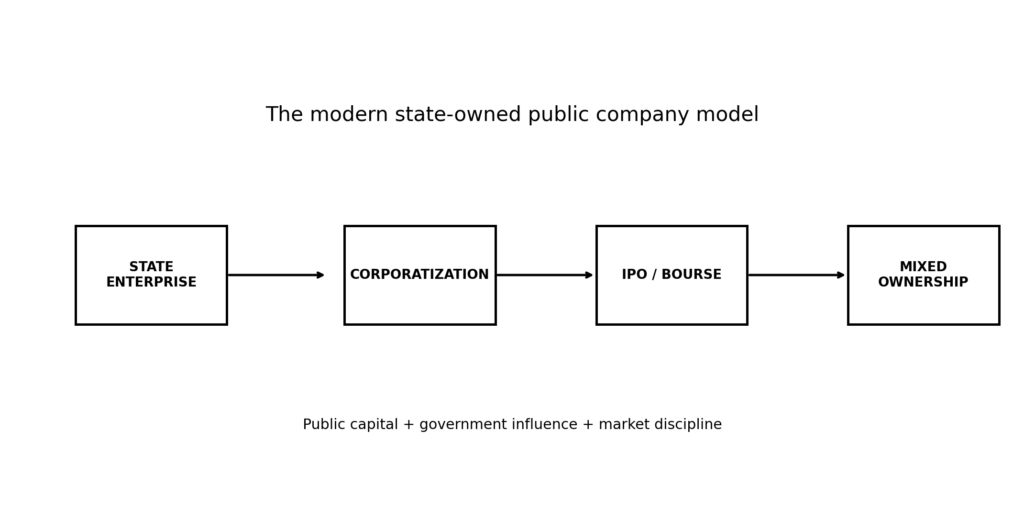
It is usually a process:
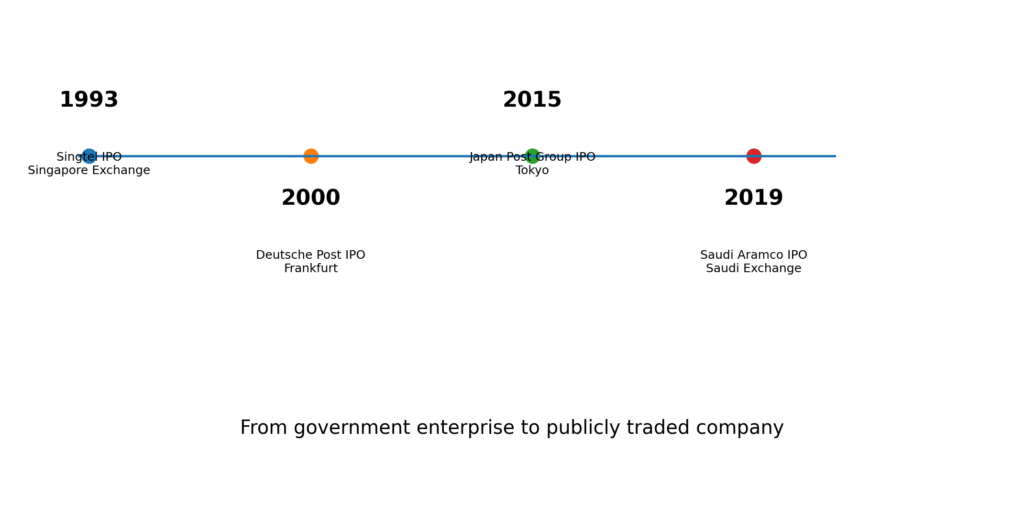
government department → corporatization → restructuring → IPO → partial government ownership → additional share sales → international expansion → modern mixed ownership.
That pattern has appeared repeatedly around the world.
Why This History Still Matters
State-owned public companies remain important because governments continue to control enormous pools of economic assets.
Energy, transportation, telecommunications, banking, postal services, infrastructure and natural resources can represent strategic national wealth.
For investors, the lesson is not that government-backed companies are automatically good or bad investments.
Instead, they should be evaluated like any other public company — while recognizing that the government may be the most powerful shareholder in the room.
For households considering investments, these stocks may be part of a broader portfolio, but they should not be evaluated in isolation. An investor seeking a good retirement planner should consider diversification, risk tolerance, taxes, income requirements and time horizon rather than selecting investments simply because a government owns part of the business.
And while international markets can make overseas investing interesting, investors should also distinguish investment research from unrelated consumer searches for travel deals to destinations connected with these companies.
The same principle applies to luxury markets. A company involved in banking, energy or telecommunications is fundamentally different from an asset such as expensive jewelry, where value can depend heavily on materials, craftsmanship, rarity and resale markets.
The enduring story of Japan Post, Deutsche Post, Singtel and Saudi Aramco is therefore bigger than privatization.
It is the story of how governments learned to turn national institutions into corporations, how corporations learned to operate under market pressure, and how citizens and international investors became participants in assets once controlled almost exclusively by the state.
The next chapter of the story may be just as interesting: governments around the world still own valuable companies, infrastructure and natural-resource assets, and future administrations will have to decide whether to keep those stakes, sell them, restructure them or use them as financial tools for the next generation.
Disclaimer
This article is intended for general news, educational and historical purposes only. It is not investment, financial, legal, tax or retirement advice and should not be interpreted as a recommendation to buy, sell or hold any security. Government ownership percentages, valuations, market prices and corporate structures can change. Historical IPO valuations should not be treated as current market valuations. Investors should consult official company filings, stock-exchange information and qualified financial professionals before making investment decisions. International securities may involve currency, political, regulatory, liquidity and market risks.
Article research sources: Japan Post Holdings, Japan Exchange Group, Japan Post, DHL Group, Germany’s Federal Ministry of Finance, Singtel, Saudi Aramco, Saudi Exchange/Tadawul and other cited sources.