By Gracus Bloom — City-Paper Automotive, Arts & Industry Desk
There is something almost magical about damascening.
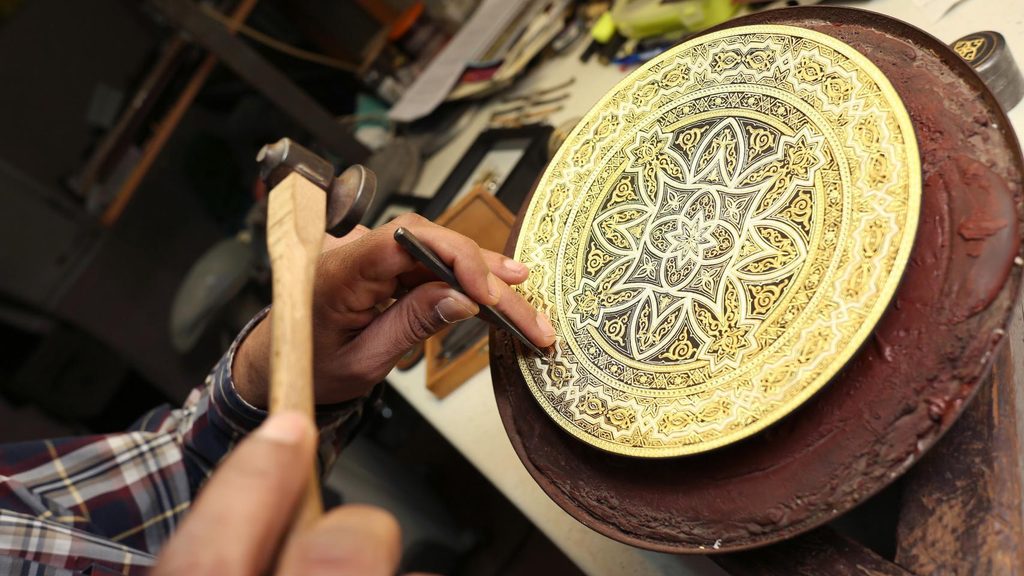
Take a piece of dark steel, cover it with incredibly fine scratches or carefully cut recesses, then force gold, silver or another contrasting metal into those tiny patterns. After polishing and darkening the background, the result can look like a miniature painting made from metal.
The technique has appeared on swords, armor, jewelry, lamps, decorative objects, furniture hardware and even some extraordinarily fancy automobiles.
And yes, damascening is still practiced today.
The surprise is that the word can describe several related decorative traditions. Traditional damascening generally means mechanically inlaying a softer metal—often gold, silver or copper—into a harder iron or steel surface. The Metropolitan Museum of Art explains that the softer metal can be hammered into recessed or cross-hatched areas and then burnished flush with the surrounding surface. (The Metropolitan Museum of Art)
There is also an American automotive use of the word. On certain luxury automobiles, particularly custom cars of the late 1920s and 1930s, “damascened” could refer to an engine-turned or patterned metal finish, rather than traditional gold-wire inlay.
That distinction makes the history particularly interesting.
What Exactly Is Damascening?
Traditional damascening is essentially metal-on-metal decoration.
A steel or iron object becomes the canvas.
The craftsperson creates a surface that can grip another metal. Depending on the particular tradition, this can involve:
- Cutting grooves
- Engraving lines
- Undercutting recesses
- Cross-hatching the steel
- Applying gold, silver or copper wire
- Applying thin metal foil
- Hammering the precious metal into the prepared surface
- Burnishing the finished design
- Darkening or patinating the background

The Metropolitan Museum describes “true damascening” as using undercut cavities so that hammered gold or silver expands into the undercuts and mechanically locks into place. A less labor-intensive approach uses a roughened or cross-hatched surface to hold foil or wire. (The Metropolitan Museum of Art)
No ordinary glue is required.
No ordinary solder joint is required.
The mechanical relationship between the metals does the work.
That is one reason the technique is so fascinating to anyone interested in old-world manufacturing.
The Famous Black-and-Gold Appearance
The classic look is instantly recognizable.
A dark black or charcoal steel background provides the contrast.
Gold or silver then creates the decoration.
The result can resemble:
- Flowers
- Vines
- Leaves
- Geometric patterns
- Stars
- Arabic-inspired ornament
- Animals
- Landscapes
- Calligraphy
- Abstract designs
The contrast is particularly dramatic because the background may be intentionally darkened while the gold or silver is polished brightly.
The Metropolitan Museum notes that the steel substrate is often patinated black specifically to heighten the contrast with polished gold, silver and copper. (The Metropolitan Museum of Art)
It Isn’t the Same Thing as Damascus Steel
This is one of the biggest points of confusion.
Damascening and Damascus steel are not the same process.
Damascus steel generally refers to steel exhibiting characteristic patterns associated historically with crucible-steel production, while modern “Damascus” blades frequently refer to pattern-welded steel.
Damascening is a surface-decoration technique.
In damascening, the underlying steel can remain structurally ordinary while the craftsperson adds another metal to its surface.
The Met specifically warns that pattern welding and Damascus steel are commonly confused with damascening. (The Metropolitan Museum of Art)
Think of it this way:
Damascus steel = the pattern is part of the metal itself.
Damascening = the pattern is added to the metal surface.

From the Middle East to Europe
The name is associated with Damascus, and the technique became strongly associated with the metalworking traditions of the Islamic world.
But the underlying idea of metal inlay is considerably older and appeared in several cultures.
The Metropolitan Museum notes that metal inlay was used on arms and armor far back into antiquity, including during the Mycenaean period. (The Metropolitan Museum of Art)
Over the centuries, different regions developed their own versions.
One of the most famous surviving traditions is Toledo, Spain.
Toledo became particularly associated with gold and silver damascening, with artisans decorating dark steel with extremely fine precious-metal designs.
Spain’s official tourism organization describes damascening as Toledo’s quintessential traditional art and notes that workshops in the city’s old town still allow visitors to see the craft being performed. (Spain.info)
The Toledo Connection
Toledo’s version became so famous that “Gold of Toledo” became almost a brand of its own.
The technique was applied to:
- Swords
- Daggers
- Shields
- Jewelry
- Plates
- Boxes
- Decorative objects
- Household pieces
- Furniture accessories
The Khalili Collection’s research on Spanish damascene identifies Eibar in Spain’s Basque Country as another major center of 19th-century damascening, particularly through the work of the Zuloaga family. (Khalili Collections)
Plácido Zuloaga became particularly famous for sophisticated damascened objects, helping transform the technique from an arms-related craft into high-end decorative art.
America Gets in on the Act
Damascening wasn’t just an imported curiosity in the United States.
American decorative-art companies adopted and adapted the technique.
One of the most important names is Tiffany & Co.
The Metropolitan Museum has a Tiffany & Co. candlestick dating to 1878, made from iron, silver, gold and copper. The museum uses the piece to demonstrate how American craftsmen employed damascening. (The Metropolitan Museum of Art)
Tiffany’s process is especially interesting because it demonstrates that American decorative-metal shops were capable of treating the technique as a serious industrial-art process rather than merely copying foreign souvenirs.
A worker could secure the steel in a pitch-filled container, prepare the surface, force gold foil into the cross-hatching and then burnish the surrounding steel.
The pitch pot was particularly clever.
It held the object securely while still allowing the metal to deform slightly under the force of the tools.
That gave the craftsperson a stable working surface without permanently clamping or damaging the object.
Tiffany Wasn’t Alone
Another fascinating American figure was Marie Zimmermann, an important early-20th-century metalworker and designer.
Her work included daggers with steel blades decorated with gold and silver damascene.
She also designed elaborate architectural and decorative metalwork.
One large commission for the Groesbeck house in Ohio included an interior fountain, lighting, hardware and other furnishings. Her work demonstrates how decorative metal techniques could be incorporated into an entire luxury interior rather than being limited to small jewelry pieces. (Antiques And The Arts Weekly –)
This is one reason fountains occasionally enter the damascening conversation.
However, there is an important distinction:
Not every decorative fountain associated with Damascus or damascene culture is actually damascened metal.
The Metropolitan Museum’s famous Damascus Room, for example, includes a fountain and represents an extraordinary Damascene interior, but the fountain and room are not simply examples of traditional gold-on-steel damascening. The room itself dates to 1707 and was moved from Damascus to New York in the 20th century. (The Metropolitan Museum of Art)
So when discussing “damascene fountains,” historians have to distinguish Damascene architecture and decorative inlay from true metal damascening.

The Automobile Connection Is Absolutely Wild
Now we get to the part that should make car enthusiasts sit up.
Damascening—or, more precisely, damascened/engine-turned metal finishing—appeared on some extremely elaborate American automobiles.
A particularly interesting example comes from Fleetwood-bodied Cadillac automobiles around 1929.
Historical Cadillac documentation describes a Fleetwood special town car displayed at the 1929 New York show under the “L’art moderne” theme.
The automobile combined black lacquer, polished metal, chrome and polished aluminum panels.
The recessed hood and cowl panels were made from polished aluminum and given an engine-turned, “Damascened” finish. (Cadillac Database)
Think about that for a second.
A luxury automobile wasn’t simply painted.
Its hood could become a piece of decorative metalwork.
The metal surface itself became part of the visual design.
And this wasn’t a basic family sedan.
It was an extravagant custom automobile intended to attract attention at an important New York automobile exhibition.
What Was Engine Turning?
Engine turning involves creating a dense pattern of overlapping circular or decorative marks on a metal surface.
On a dashboard, engine compartment panel or hood, the pattern can catch light in hundreds of tiny reflections.
The Cadillac historical reference describes damascening in this automotive context as a form of engine turning that created ornate metal finishes. (Cadillac Database)
This is different from the classic Toledo method of hammering gold wire into steel.
But visually, the connection makes sense:
Both turn an otherwise ordinary metal surface into something decorative and luxurious.
And that was precisely the point.
A Fancy Car Was Also a Rolling Showpiece
During the classic-car era, coachbuilders had tremendous freedom.
A wealthy customer could order a car with:
- Custom bodywork
- Special paint
- Exotic wood
- Hand-finished aluminum
- Engine-turned panels
- Custom dashboards
- Special upholstery
- Chrome-plated hardware
- Gold or silver decorative details
In other words, the automobile could be treated like a piece of furniture, jewelry and mechanical engineering all at once.
That is why surviving custom automobiles from the 1920s and 1930s can be so spectacular.

The Technical Side of the Craft
Damascening looks decorative, but the underlying process is surprisingly technical.
A simplified traditional sequence looks like this:
1. Prepare the steel
The surface must be clean and properly prepared.
2. Create the pattern
The craftsperson cuts grooves, recesses or cross-hatching.
3. Prepare the precious metal
Gold, silver or copper can be reduced to extremely fine wire or foil.
4. Inlay
The softer metal is mechanically forced into the prepared steel.
5. Hammer and secure
Careful hammering expands the softer material into the prepared surface.
6. Burnish
The surface is compressed and smoothed.
7. Patinate
The background can be darkened to increase contrast.
8. Final polish
The precious-metal areas are polished while the dark background remains contrasting.
The Metropolitan Museum’s technical demonstration describes using wooden and copper tools followed by a steel burnisher to flatten and secure the inlay. (The Metropolitan Museum of Art)
The “Trade Math” Behind the Craft
There isn’t a complicated equation required to make damascening.
The challenge is precision.
Imagine a decorative panel measuring:
12 inches × 8 inches
That’s 96 square inches.
Now imagine a design requiring thousands of individual lines, cross-hatches or points of contact.
The average amount of metal removed at each location may be tiny, but the cumulative work becomes enormous.
The craft therefore becomes a classic example of a trade where:
precision × repetition × patience = finished value
That is also why restoration shops need people who understand both traditional handwork and modern metal finishing.
Is Damascening Still Practiced Today?
Absolutely.
But it is a specialized craft rather than a mass-production process.
Toledo’s tourism authorities say visitors can still see artisans practicing the craft in workshops in the historic city center. (Toledo Travel)
There are also contemporary artists working with damascene traditions in the United States.
One especially interesting example is Namu Cho, a Maryland-based metalsmith whose work uses Korean damascene, or po mok sang guem, incorporating 24-karat gold into steel.
The Louis Comfort Tiffany Foundation documents Cho’s damascene jewelry, including pieces using 24-karat gold inlaid into steel. (The Louis Comfort Tiffany Foundation)
The 2026 Smithsonian Craft Show also lists Namu and Jin Cho and displays their damascene work using 24-karat gold inlaid on steel. (Smithsonian Craft Show)
So the answer to the question “is damascening still practiced today?” is definitely yes.
It is simply no longer something most people encounter every day.

A Modern U.S. Damascene Specialist
Namu Cho’s career is particularly interesting because it demonstrates how an ancient technique can migrate across cultures.
Cho was born in Seoul, studied in Korea and the United States, and resides in Bethesda, Maryland. His work has been exhibited at venues and events including the Smithsonian Craft Show and exhibitions of contemporary metalwork. (The Louis Comfort Tiffany Foundation)
His work also illustrates an important point:
Modern damascening doesn’t have to look antique.
A contemporary artist can use traditional inlay methods to create abstract shapes, jewelry, nature imagery or modern geometric compositions.
The technique survived partly because artists keep changing what they do with it.
A Craft Hidden in Plain Sight
One reason damascening isn’t better known may be that the technique hides in the finished object.
You see the gold.
You see the silver.
You see the swirling metal.
But you don’t immediately see the thousands of tiny mechanical decisions that hold everything together.
A good damascener must control:
- Tool pressure
- Groove depth
- Metal thickness
- Inlay placement
- Hammering
- Surface flatness
- Burnishing
- Patination
- Polishing
A mistake can ruin a highly valuable piece.
And correcting a mistake isn’t always as simple as sanding it away.
Why the Craft Could Be a Good Trade to Get Into
For someone looking for a good trade to get in, damascening is obviously a very specialized choice.
But the broader lesson is more practical.
The skills surrounding traditional metal decoration overlap with modern trades such as:
- Metal finishing
- Engraving
- Jewelry fabrication
- Toolmaking
- Restoration
- Polishing
- Precision machining
- Automotive restoration
- Architectural metalwork
- Museum conservation
Someone who understands how metal behaves, how surfaces are prepared and how finishes are created can potentially move between several industries.
That is one reason metal finishing shops hiring can be worth watching for mechanically inclined workers who enjoy detailed hands-on work.
From Museum Piece to Modern Workshop
Walk through an American museum and you may find damascene in several different contexts.
The Metropolitan Museum has American Tiffany damascene.
The Smithsonian has exhibited extraordinary Islamic inlaid metalwork.
The Philadelphia Museum of Art has a 1895 Damascene Vase in its collection and describes damascening as the inlaying of gold or silver into dark oxidized metal. (Philadelphia Museum of Art)
The National Museum of Asian Art has also presented exhibitions exploring traditional metalwork techniques, including Japanese inlay methods related to damascene. (Smithsonian National Museum of Asian Art)
And the automotive world has preserved examples where decorative engine turning was described as damascened.
It is therefore possible to trace the idea across museums, jewelry studios, automobiles, architecture and industrial finishing.
The Future of Damascening
The biggest threat isn’t that the technique doesn’t work.
It does.
The problem is time.
Modern manufacturing can create patterns extremely quickly.
Computer-controlled machines can engrave, mill, polish and texture metal with extraordinary precision.
A person spending hours or days creating an intricate pattern by hand cannot compete with a machine on price.
But that’s also why handmade damascene remains valuable.
The buyer isn’t paying simply for a pattern.
They’re paying for:
skill + time + history + craftsmanship.
And that is exactly the same reason collectors continue to pay attention to hand-built automobiles, hand-polished metalwork and historic restoration.
The Strange Journey of Damascening
Damascening has traveled an extraordinary road.
It moved through ancient metalworking traditions, became associated with Damascus and Islamic decorative arts, flourished in Spain, became famous in Toledo, influenced European decorative metalwork and found a home in American luxury arts.
Tiffany & Co. used the technique.
American artists adapted it.
Luxury automobiles used damascened or engine-turned metal surfaces.
Museums preserved it.
And contemporary artists continue to practice it.
So the next time you see a black-and-gold metal object with impossibly fine decoration, don’t assume it was simply painted.
Look closely.
You may be looking at one of the world’s oldest examples of precision metal finishing.
And somewhere, even today, there is still a craftsperson sitting at a bench, holding a tiny tool against a sheet of steel, hammering a sliver of precious metal into place—one tiny strike at a time.
If that sounds like the sort of work you could enjoy, a career in precision metal finishing may be a good trade to get in.
And if you’re traveling to see the real thing, Toledo remains one of the world’s best places to encounter traditional damascening firsthand—though travelers should shop carefully for authentic handmade work rather than assuming every inexpensive souvenir was produced using traditional methods. (Toledo Travel)
For visitors planning the trip, comparing flights and looking for a cheap hotel near Toledo’s historic center can make it easier to spend time visiting the workshops rather than rushing through them.
The Bottom Line
Is damascening still practiced today?
Yes.
It survives in Toledo, in specialized contemporary metalworking, in jewelry, in museums and in the hands of artists who have adapted centuries-old techniques for modern audiences.
The machines may be faster.
The craftsperson is still more interesting.