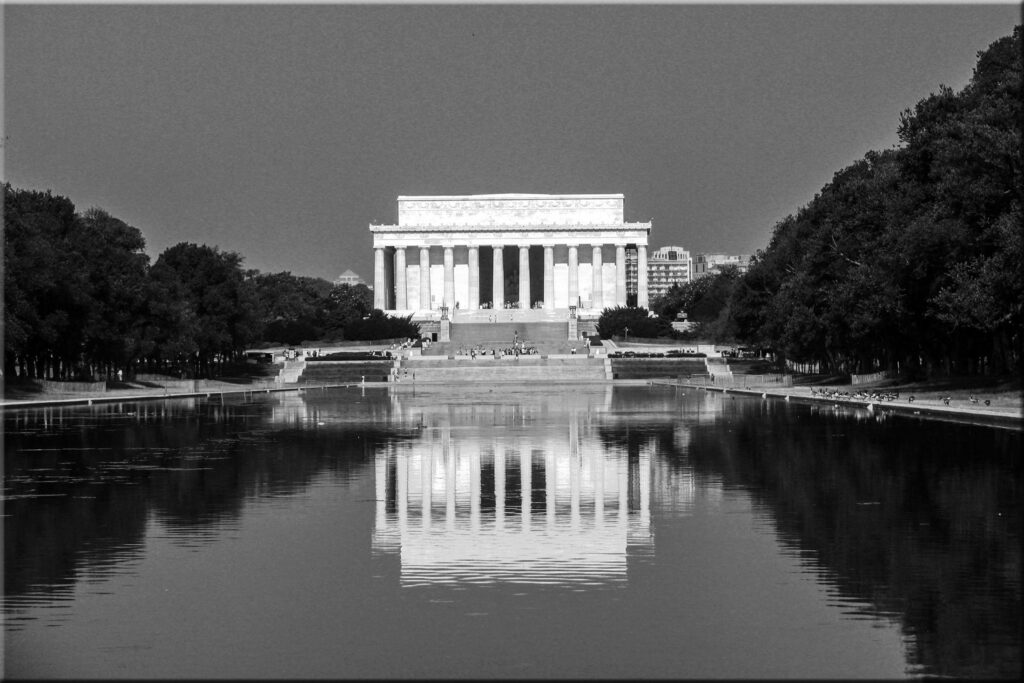
Few places in Washington, D.C., are as instantly recognizable as the Lincoln Memorial Reflecting Pool. Stretching between the Lincoln Memorial and Washington Monument, the long sheet of water has become one of America’s most photographed landscapes and the setting for presidential events, demonstrations, celebrations and countless family photographs.
But the pool wasn’t simply a decorative addition. It was part of a much larger plan to transform Washington’s monumental core into a carefully designed national landscape.
The Idea Started With the McMillan Plan
The story begins with the 1902 McMillan Commission plan, which envisioned a formal monumental axis running through the center of Washington. Landscape architects and architects wanted the area to have the grand, symmetrical appearance associated with European formal gardens.
The future Reflecting Pool became an important component of that vision.
The design evolved through the work of Charles F. McKim, Frederick Law Olmsted Jr. and Lincoln Memorial architect Henry Bacon. Early concepts were considerably more complicated, including a proposed cruciform pool. The final design became a long, narrow basin extending eastward from the Lincoln Memorial. (NPGallery)
The Lincoln Memorial itself was dedicated in 1922, while construction of the Reflecting Pool followed and was completed in 1924. (National Park Service)
The result was a remarkable visual trick.
Standing near the Lincoln Memorial, visitors could see the Washington Monument reflected in the water. From the opposite direction, the Lincoln Memorial became the dominant reflection.
What Was It Made From?
Underneath the water is an engineered structure rather than simply a hole dug into the Mall.
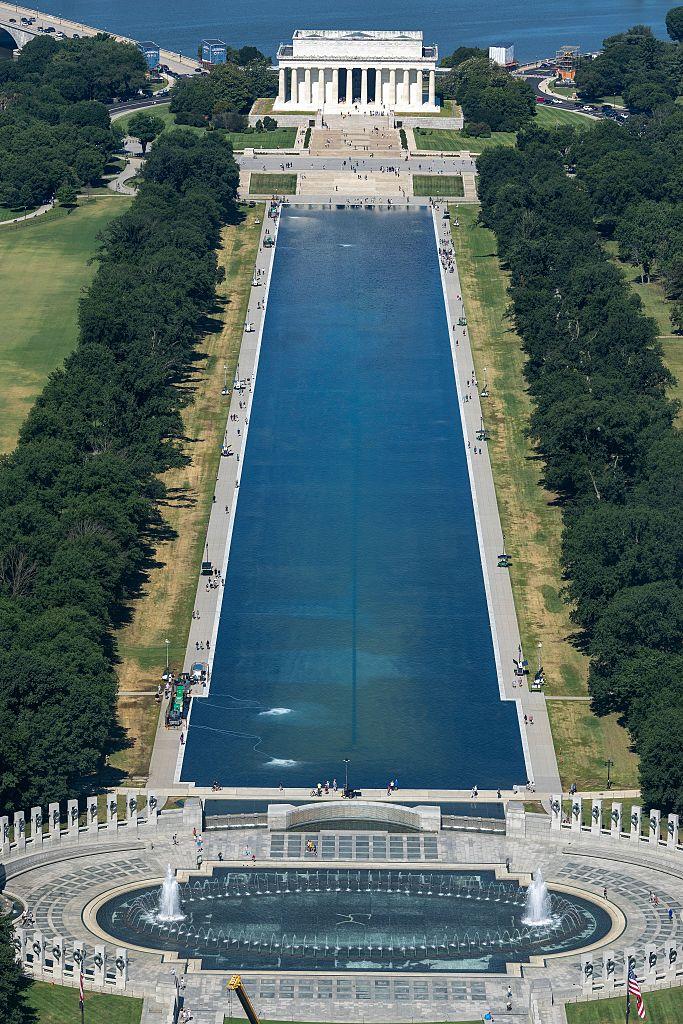
The historic basin was constructed from concrete, while the perimeter is finished with granite coping. The National Register documentation describes the pool as approximately 167 feet wide and 2,029 feet long. (NPGallery)
The original basin was constructed without foundation piles. Soil settlement subsequently created structural problems, and a reinforced concrete slab foundation was added in 1929. (Planning NPS)
The granite and other stonework contributed to the formal architectural appearance. The surrounding landscape was equally important: parallel rows of elm trees, broad walks and carefully maintained lawns frame the water.
The pool therefore isn’t just a body of water. It is a combination of concrete engineering, stonework, water-management infrastructure, landscape architecture and historic preservation.
That makes maintenance a surprisingly complicated job.
Where Did the Materials Come From?
The Reflecting Pool’s construction was part of the enormous building and landscaping effort surrounding the Lincoln Memorial and National Mall.
Stone used throughout the broader memorial landscape came from American quarries. The National Park Service, for example, documents the use of granite and marble from different parts of the United States elsewhere in the Mall’s memorial landscape. The Lincoln Memorial itself famously used Georgia marble for Abraham Lincoln’s statue, which was carved from 28 blocks at a New York studio. (National Park Service)
For the pool itself, the major structural material was concrete, with granite used for the coping and associated architectural elements. The important point is that the project relied on American construction materials and a large workforce capable of handling massive quantities of concrete, stone, excavation and landscaping.
A Pool That Has Needed Repairs for Generations
A century of exposure, weather, visitors and water inevitably takes its toll.
The Reflecting Pool has undergone multiple major rehabilitation efforts.
A full reconstruction in 1981 addressed water leakage, intake and drainage problems. Engineering concerns continued, and later rehabilitation became necessary. (Planning NPS)
The most significant modern rehabilitation occurred in 2011–2012, when the basin was reconstructed and improvements were made to accessibility and security around the Lincoln Memorial. (NPGallery)
That project illustrates an important reality about historic landmarks: preservation doesn’t necessarily mean leaving everything untouched.
Sometimes preserving a historic structure means replacing failing infrastructure while maintaining its historic appearance.
The 2026 Update: A New Lining
The latest chapter arrived in 2026.
The National Park Service undertook work to clean the pool, repair joints and install lining material designed to improve the basin and reduce future repair requirements. Temporary closures began April 10, 2026, as crews worked on the project. (National Park Service)
The work required portions of the pool and adjacent walkways to be closed while equipment and construction operations were in place.
In July, NPS reported that closures around the Reflecting Pool were being extended while the work continued, with the affected footprint expected to shrink as equipment was removed and portions of the site became safe to reopen. (National Park Service)
For visitors, that meant something unusual: one of America’s most familiar photographs temporarily became a construction zone.
For preservation professionals, however, the work represents an attempt to keep the historic landscape functioning for another generation.
Why the Lining Matters
Water is one of the toughest forces for a structure to manage.
Even a shallow decorative pool has to retain enormous quantities of water. Small cracks, deteriorated joints or damaged surfaces can eventually allow water to escape into the surrounding structure.
A modern lining provides another layer of protection.
The objective isn’t simply to make the pool look better. It is to reduce leakage, protect the underlying structure and potentially reduce the frequency of major repairs.
This is where historic preservation meets modern industrial craftsmanship.
Concrete repair, waterproofing, stone maintenance, surface preparation and finishing all require specialized skills.
A project that looks like “just a pool” from the sidewalk can involve engineers, construction specialists, electricians, plumbers, equipment operators, masons and other skilled trades.

The Reflecting Pool as a National Stage
The pool’s importance goes far beyond engineering.
It has been the backdrop for some of America’s most memorable public events.
Martin Luther King Jr.’s 1963 March on Washington took place around the Lincoln Memorial, with the Reflecting Pool becoming part of the historic scene.
Presidential inaugurations, memorial ceremonies, public gatherings and national celebrations have repeatedly used the surrounding landscape.
The pool has also become a cultural symbol through movies, television, photography and tourism.
That creates an unusual preservation challenge.
Millions of visitors expect the landmark to look exactly as they remember it while the infrastructure underneath continues aging.
A Good Industrial Polisher Has a Role in Preservation
Historic preservation frequently depends on trades that don’t receive much attention.
Stone must be cleaned without damaging historic surfaces.
Metal components can require careful resurfacing.
Concrete surfaces need specialized repair.
Granite coping has to remain structurally sound and visually consistent.
That is why skills associated with a good industrial polisher and other finishing professionals can be valuable throughout the preservation industry.
Historic sites aren’t museums sealed inside glass cases. They are working physical environments exposed to rain, snow, heat, pollution and millions of footsteps.
Keeping them looking good requires people who understand materials.
Visiting Washington to See It
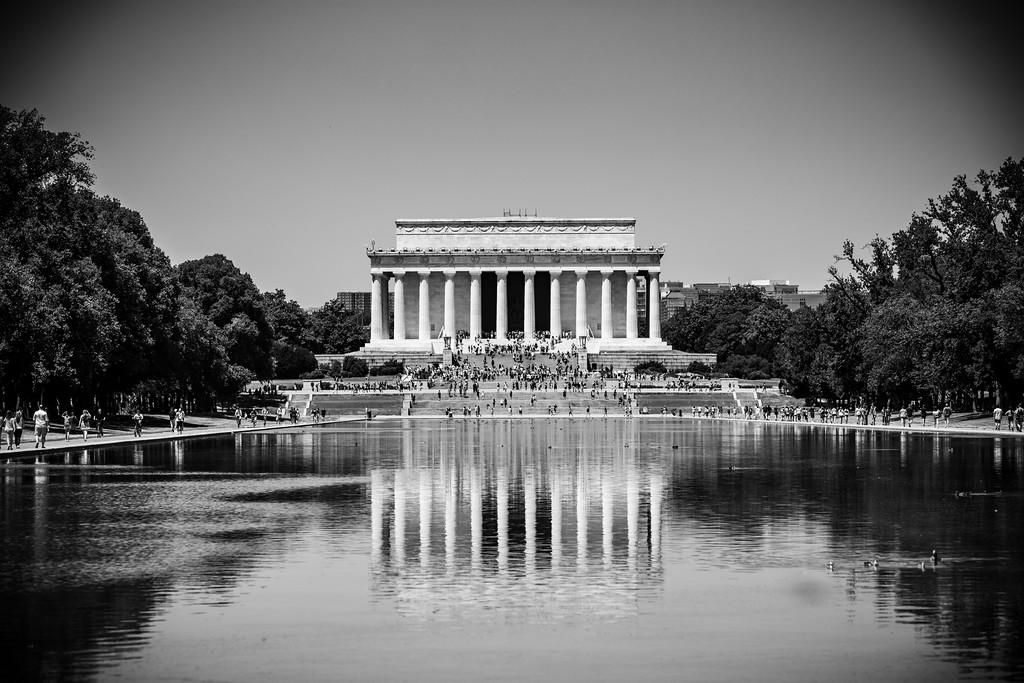
For visitors planning a trip to Washington, the Reflecting Pool remains one of the easiest landmarks to combine with other major attractions.
The Lincoln Memorial, Washington Monument, World War II Memorial, Vietnam Veterans Memorial and National Mall are all within the broader monumental landscape.
Travelers looking for a nice hotel in DC may want to consider transportation access as well as price. Washington’s Metro system can make it considerably easier to reach the National Mall without dealing with downtown parking.
Visitors should also check National Park Service notices before visiting because preservation projects and special events can temporarily affect access.
More Than a Reflection
The Reflecting Pool may look deceptively simple.
It is a rectangle filled with water.
But underneath that simple appearance is more than a century of American engineering and preservation.
The project grew from the McMillan Plan, became part of the Lincoln Memorial landscape in the 1920s, required structural modifications in the 1920s and major reconstruction in 1981 and 2011–12. Now, in 2026, another generation of preservation work is addressing the basin, joints and waterproofing system. (NPGallery)
And perhaps that is the most interesting thing about the Reflecting Pool.
It isn’t frozen in history.
It is history being maintained in real time.
Every repaired joint, restored surface and replaced piece of infrastructure allows the familiar landscape to continue serving the public.
For visitors, the result is a beautiful reflection.
For engineers and preservation crews, it is a century-old structure that still has to work.
And for Washington, it remains one of the clearest examples of how architecture, engineering, landscaping and American history can come together in one extraordinary place.
2026 Preservation Note
As of the latest National Park Service information available in 2026, the Reflecting Pool has been undergoing lining and repair work, with temporary closures used to protect visitors and allow construction operations. Visitors should check the NPS before traveling because access conditions can change as work progresses. (National Park Service)Disclaimer: This article is intended for general historical and informational purposes. Construction schedules, closures and preservation conditions can change. Consult the National Park Service for current visitor information before traveling