Rosemary, peppermint, lavender and cedarwood are attracting attention as natural scalp-care ingredients—but what does the science actually say?
Hair thinning is one of those health concerns that can be surprisingly complicated. Genetics, age, hormones, stress, nutrition, medications and scalp conditions can all play a role. For people with androgenetic alopecia—often called male- or female-pattern hair loss—one of the major biological players is dihydrotestosterone, better known as DHT.
DHT is an androgen made from testosterone. In genetically susceptible hair follicles, exposure to DHT can contribute to follicle miniaturization, producing progressively thinner hairs and a shorter growth phase.
That has led to growing interest in natural approaches, including essential oils.
But there is an important distinction between supporting a healthy scalp and hair-growth environment and actually blocking DHT. At present, essential oils should not be considered proven substitutes for established medical treatments for androgenetic alopecia.
Still, several oils have interesting research behind them. Rosemary has human clinical evidence, peppermint has promising animal research, and lavender and cedarwood have appeared in a controlled aromatherapy study involving alopecia areata.
Here are four worth knowing about.
1. Rosemary Essential Oil
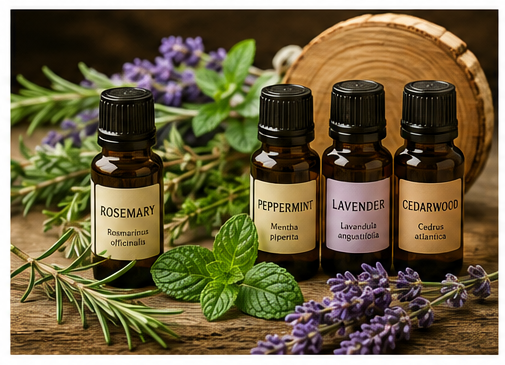
Rosemary essential oil is probably the most interesting essential oil when it comes to hair-loss research.
A randomized comparative trial published in SKINmed followed 100 people with androgenetic alopecia for six months. Participants were assigned to rosemary oil or 2% minoxidil. Both groups showed a significant increase in hair count after six months, and the researchers did not find a significant difference in hair count between the two groups at the study endpoints.
That does not prove rosemary oil is an equivalent replacement for minoxidil. It was a relatively small study, and additional research is needed.
Why might rosemary help?
Researchers have proposed several possibilities, including effects on scalp circulation and the hair-growth cycle. Rosemary also contains biologically active compounds with antioxidant and anti-inflammatory properties.
Importantly, the clinical evidence supports rosemary as a potential hair-growth aid—it does not establish that rosemary oil directly blocks DHT in humans.
How to use it
A conservative scalp blend can be made by adding a small amount of rosemary essential oil to a carrier such as jojoba oil.
For example:
- 1 tablespoon jojoba oil
- 2–3 drops rosemary essential oil
Massage a small amount into the scalp and leave it on for approximately 20–30 minutes before washing.
For people who tolerate it well, a leave-on formulation can also be used at an appropriately diluted concentration.
What complements rosemary?
Jojoba oil is an excellent companion because it provides a lightweight carrier that is easy to massage into the scalp.
Castor oil can also be incorporated in small amounts into a conditioning treatment, although there is not good evidence that castor oil itself treats DHT-related hair loss.
2. Peppermint Essential Oil
Peppermint oil is another popular ingredient in natural hair-care products.
The strongest frequently cited hair-growth evidence comes from an animal study rather than a human clinical trial. Researchers applied 3% peppermint oil to mice and observed increased hair growth, follicle number, follicle depth and other markers associated with the hair-growth phase.
That is interesting—but mice are not people.
There is currently insufficient clinical evidence to conclude that peppermint oil blocks DHT or reliably regrows hair in humans.
Why is it nevertheless popular?
Peppermint contains menthol, which produces its familiar cooling sensation. It may also affect the scalp environment and has been investigated for biological effects that could potentially support hair growth.
How to use it
Peppermint is potent, so it should be diluted rather than applied directly to the scalp.
Try:
- 1 tablespoon jojoba or grapeseed oil
- 1–2 drops peppermint essential oil
Massage lightly into the scalp and wash out after about 20–30 minutes.
Because peppermint can irritate sensitive skin, start with a very small amount.
What complements peppermint?
Jojoba oil works well as a lightweight carrier.
Aloe vera gel can also complement a scalp-care routine, particularly for people who want a cooling, soothing formulation. Use a properly formulated cosmetic aloe product rather than assuming fresh aloe is automatically appropriate for every scalp.
3. Lavender Essential Oil
Lavender is particularly interesting because it has appeared in human research involving hair loss.
In a 1998 randomized, double-blind controlled trial involving people with alopecia areata, researchers used a combination of thyme, rosemary, lavender and cedarwood essential oils diluted in jojoba and grapeseed carrier oils. The active aromatherapy group had a higher rate of improvement than the carrier-oil control group.
However, this study does not prove lavender alone treats DHT-related hair loss.
It also studied alopecia areata, which is different from androgenetic alopecia.
So why include lavender?
Lavender is commonly used in scalp-care formulations because of its aroma and its potential soothing properties. It may make sense as a complementary ingredient in a conditioning scalp blend rather than being promoted as a proven DHT blocker.
How to use it
A simple blend might contain:
- 1 tablespoon jojoba oil
- 2 drops lavender essential oil
- 1 drop rosemary essential oil
Massage into the scalp for several minutes and wash thoroughly afterward.
What complements lavender?
Jojoba oil provides the primary carrier.
Rosemary oil is a logical companion because rosemary has considerably more direct clinical research involving androgenetic alopecia.
4. Cedarwood Essential Oil
Cedarwood is the fourth oil that frequently appears in discussions about natural hair treatments.
Its most interesting human evidence comes from the same aromatherapy study that used thyme, rosemary, lavender and cedarwood. The researchers did not isolate cedarwood, however, so it is impossible to determine how much of the reported improvement came from cedarwood itself.
This distinction matters.
There is a big difference between saying:
“Cedarwood was included in a study where an essential-oil combination produced improvement.”
and saying:
“Cedarwood is clinically proven to block DHT.”
The first statement is supported by research. The second is not.

How to use it
For a conditioning scalp treatment:
- 1 tablespoon jojoba oil
- 1–2 drops cedarwood essential oil
- 1–2 drops rosemary essential oil
Massage gently into the scalp and wash afterward.
What complements cedarwood?
Rosemary makes a logical partner because of its stronger hair-growth research.
Jojoba oil provides a simple carrier and makes the essential oils easier to distribute across the scalp.
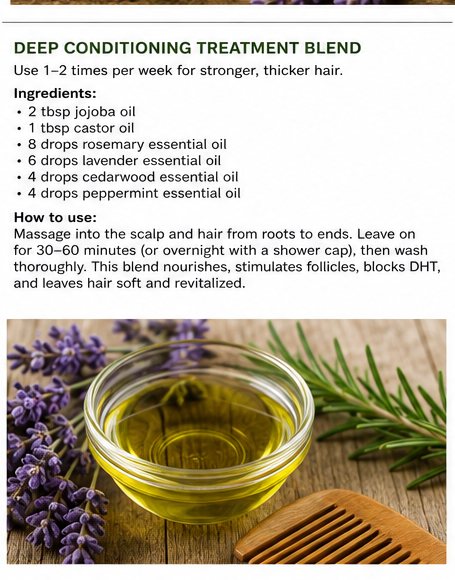
A Deep-Conditioning Scalp Blend
For someone looking for a once- or twice-weekly conditioning treatment, a simple blend can combine the four oils without making the formulation excessively concentrated.
Try:
- 2 tablespoons jojoba oil
- 1 teaspoon castor oil
- 3 drops rosemary essential oil
- 1 drop peppermint essential oil
- 1 drop lavender essential oil
- 1 drop cedarwood essential oil
Mix thoroughly.
Apply a small amount to the scalp and massage gently for several minutes. Leave it on for approximately 20–30 minutes before washing.
This is intended as a cosmetic scalp-conditioning treatment, not a medically proven DHT-blocking therapy.
For someone with sensitive skin, an even lower concentration is appropriate.
A Lighter Daily-Wear Scalp Formula
Daily wear requires a different approach.
A heavy oil treatment can leave hair greasy and may not be practical for someone going to work or spending the day outdoors.
A lightweight scalp serum or properly preserved water-based cosmetic formulation may be easier to use.
One simple oil-based leave-on option is:
- 1 tablespoon jojoba oil
- 1 drop rosemary essential oil
- 1 drop lavender essential oil
Use only a small amount, concentrating on areas where the scalp is visible.
The objective is not to soak the hair. A few drops distributed across the scalp can be enough.
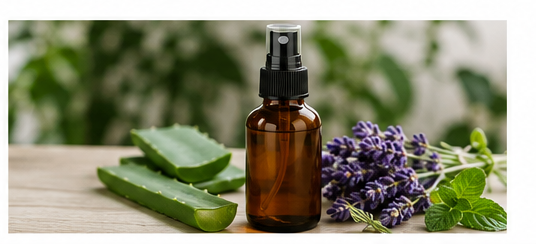
For a commercial water-based scalp spray, follow the manufacturer’s formulation instructions rather than simply adding essential oils to water. Essential oils do not naturally mix with water, and an improperly formulated homemade spray can separate and distribute concentrated droplets unevenly.
Why Carrier Oils Matter
Essential oils are extremely concentrated plant extracts.
Putting them directly onto the scalp can increase the risk of irritation, burning or allergic reactions.
A carrier oil helps distribute the essential oil across the skin.
Popular choices include:
Jojoba oil: lightweight and convenient for scalp applications.
Grapeseed oil: relatively light and commonly used in massage and cosmetic formulations.
Fractionated coconut oil: lightweight and less greasy than some traditional oils.
Castor oil: thick and highly conditioning, but best used as a smaller component of a blend because of its heavy texture.
The carrier oil does not have to be exotic. The most important consideration is whether the finished product is comfortable and tolerated by the individual.
Essential Oil Safety Should Not Be Ignored
Natural does not automatically mean risk-free.
Essential oils can cause irritation or allergic reactions, particularly when used at excessive concentrations. The National Center for Complementary and Integrative Health notes that topical essential oils can cause skin irritation and allergic reactions.
A sensible approach is to patch-test a diluted preparation on a small area before applying it broadly.
Do not swallow essential oils.
Avoid applying concentrated essential oils around the eyes.
People who are pregnant, breastfeeding, taking medications, have significant scalp disease or have a history of severe allergies should discuss topical essential-oil use with a healthcare professional.
Peppermint oil can also cause skin irritation in some people.
So, Which One Is Best?
If the question is which of these four has the most interesting evidence for pattern hair loss, rosemary currently stands out.
Peppermint is intriguing but relies heavily on animal research.
Lavender and cedarwood have been studied as components of an aromatherapy combination, but that study involved alopecia areata rather than androgenetic alopecia.
None should be marketed as a proven natural DHT blocker.
That distinction is important because progressive hair loss can have many causes. A dermatologist can determine whether the problem is androgenetic alopecia, alopecia areata, nutritional deficiency, medication-related shedding, thyroid disease, scalp inflammation or another condition.
For someone who wants a natural scalp-care routine, however, properly diluted rosemary, peppermint, lavender and cedarwood can be considered as complementary cosmetic ingredients.
The best approach is to think of essential oils as supporting players rather than miracle cures.
Consistent scalp care, adequate nutrition, gentle hair handling and an accurate diagnosis remain far more important than simply adding more drops of oil.
And when hair loss is progressing rapidly, the sooner the underlying cause is identified, the more treatment options are generally available.