How a simple flame helped illuminate ancient civilizations, colonial America, scientific discovery, and the endless human search for knowledge.
For thousands of years, a small flame has helped light the way toward human progress. What began with the mastery of fire eventually developed into oil lamps, candles, lanterns, gas lighting, and the electric lightbulb. The story of the candle is about far more than wax and a wick. It is a story about humanity’s determination to overcome darkness, extend the working day, preserve knowledge, and create opportunities for discovery.
Imagine a world without electric lights. When the sun disappeared below the horizon, work became difficult, reading required precious fuel, and families gathered around whatever light they could afford. Craftspeople, farmers, scholars, merchants, and writers all faced the same limitation: daylight was a resource that could not be stored.
The humble candle helped change that equation. Its flame made it possible to work, study, pray, write, and exchange ideas after sunset. Although candles did not single-handedly create civilization, they formed part of a long chain of inventions that gave people greater control over their environment.
1. The First Flames: Ancient Beginnings

Long before candles became familiar household objects, early humans learned to control fire. Archaeological evidence indicates that people used fire hundreds of thousands of years ago, although the timing and nature of its earliest controlled use remain subjects of research.
Fire provided warmth, protection, cooking, and light. Torches and burning materials offered ways to illuminate caves and outdoor spaces, while lamps made from stone or other natural materials could hold animal fat and a wick.
By ancient Egyptian times, people used lamps fueled by animal fat and vegetable oils. Plant fibers could act as wicks, drawing fuel toward a flame. These lamps were important predecessors of later candle and lamp technologies.
Candles, which generally use a solid fuel such as tallow or wax surrounding a wick, developed through ancient traditions whose precise origins are difficult to establish. Early candles could be smoky, uneven, and expensive to maintain. Nevertheless, they offered a practical way to carry light from one place to another.
Light also acquired spiritual meaning. Lamps and candles appeared in religious ceremonies, temples, funerals, and household rituals. Their flames could symbolize life, remembrance, hope, purity, and the presence of the divine.
The candle’s importance therefore extended beyond practical illumination. It became an enduring symbol of human aspiration: even a small light could push back the darkness.
2. Spreading Light Around the World
As civilizations expanded their trade networks, lighting technologies and materials traveled with merchants, craftspeople, and migrants. Different regions developed methods suited to the fuels and resources available to them.
The Greeks and Romans used oil lamps extensively, while candles also became familiar in the Roman world. Tallow, made from rendered animal fat, provided one relatively accessible candle material. Beeswax offered another option, generally producing a cleaner-smelling flame but often costing more.
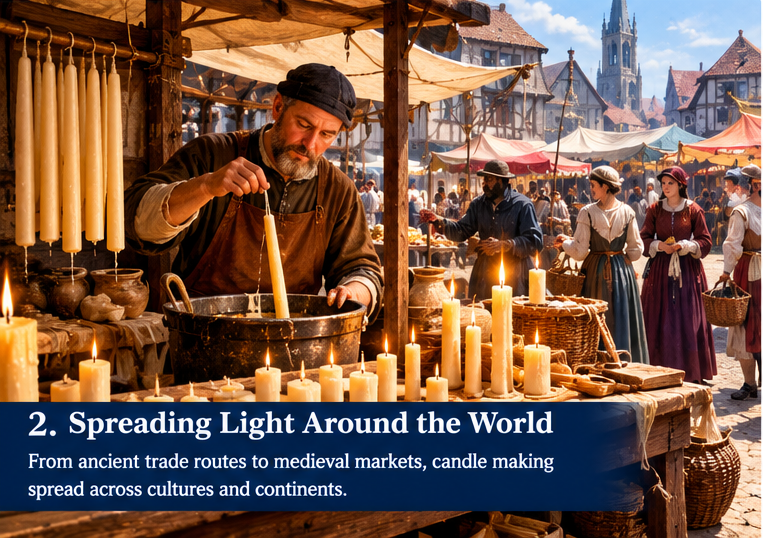
In medieval Europe, candles became important in homes, churches, monasteries, workshops, and public buildings. Religious institutions required dependable lighting for evening services and devotional activities. Wealthier households could afford better-quality candles, while less affluent families often relied on cheaper and smokier alternatives.
Across Asia, lighting traditions included oil lamps fueled by vegetable oils and other locally available substances. Candles and related lighting practices varied across cultures, and it would be misleading to imagine that every region followed the same path from oil lamps to wax candles.
Trade nevertheless encouraged the exchange of materials, craftsmanship, and ideas. The wider networks associated with the Silk Road helped connect distant societies, although the spread of particular candle-making methods cannot always be traced to a single route.
Over time, candle makers improved their products through better wick materials, more consistent fuel preparation, and more refined manufacturing. Candles became useful not only for illumination but also for religious observances, timekeeping, ceremonies, and domestic life.
The underlying principle was remarkably simple: a wick draws fuel toward a flame, allowing combustion to continue as long as the necessary fuel and oxygen are available.
3. The Candle in Colonial America
When European settlers established communities in North America, they brought candle-making knowledge with them. In places where imported candles were costly or unavailable, households could produce their own lighting from local materials.
Animal fat could be rendered into tallow, while beeswax was another possible source of candle fuel. Families might dip a wick repeatedly into melted tallow or wax, allowing successive layers to build into a candle. Molds offered another way to shape candles more consistently.
Candle making became part of domestic production, alongside activities such as spinning, weaving, food preservation, and soap making. It was labor-intensive work, but the result provided a useful source of light for homes, farms, shops, and meeting places.
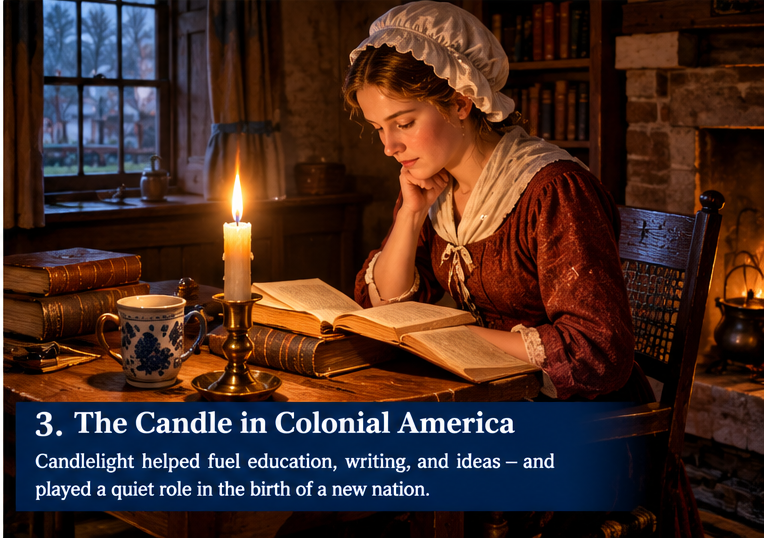
In colonial communities, a candle could help a family prepare food, mend clothing, finish household accounts, or read after sunset. It could also illuminate the work of printers, merchants, teachers, and writers.
The importance of artificial light to intellectual life should not be underestimated. Reading and writing after dark became more practical when people could obtain a reliable light source. Yet fuel was never free: candles had to be purchased or made, and households often used them carefully.
Candles also appeared in public and religious life. Churches, meetinghouses, inns, and businesses needed lighting for evening activities, although the methods and availability of illumination differed according to wealth, location, and local custom.
The candle thus played a modest but meaningful role in the daily life of colonial America. It helped people make more use of their evenings, even though it did not eliminate the many practical limits imposed by darkness.
4. The Spark of Innovation: From Candles to Modern Lighting
The candle was never the final destination. As scientists and inventors explored ways to produce safer, brighter, and more affordable light, one technology followed another.
During the eighteenth century, improvements in candle materials and manufacturing helped create more consistent products. In the nineteenth century, stearin candles and paraffin wax became increasingly important. Paraffin, produced from petroleum refining, helped make candles more economical and dependable.
Meanwhile, oil lamps improved. In the late eighteenth century, Swiss inventor Aimé Argand developed an influential lamp design that used a cylindrical wick and a glass chimney to improve combustion and brightness.
The nineteenth century also saw the development of gas lighting. Gas lamps illuminated streets, public buildings, shops, and homes in places where gas infrastructure could be installed. For some urban residents, this represented a major improvement over candles and simple oil lamps.
Kerosene lamps became another important source of household lighting. Their use expanded during the nineteenth century as petroleum production and distribution developed. They could provide brighter illumination than many ordinary candles, although they also required careful handling because of fire and fuel hazards.
Then came electric lighting.
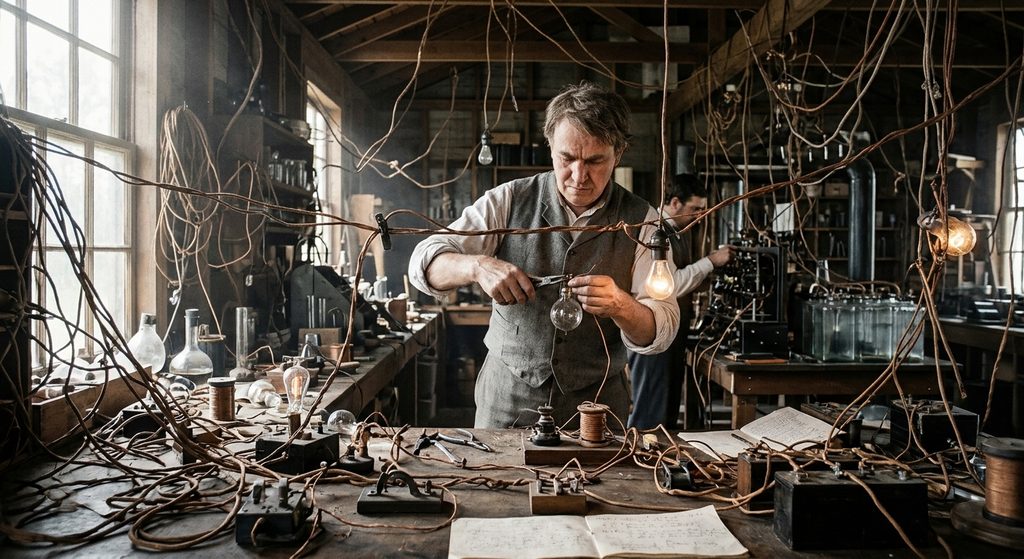
Thomas Edison and his collaborators developed a commercially practical incandescent lighting system in the late nineteenth century. Edison was not the sole inventor of the electric lightbulb; many scientists and inventors had experimented with incandescent lighting before him. His achievement lay in developing and promoting a practical system that included durable lamps and the supporting electrical infrastructure.
The first commercially important incandescent systems helped transform the way people illuminated buildings and streets. Electricity gradually reduced dependence on open flames for everyday lighting, particularly in places where electrical networks became available.
Each step built upon earlier discoveries. The candle did not directly cause every later invention, but the long human effort to produce dependable light illustrates how incremental improvements can support larger technological changes.
5. Light, Literacy, and the Exchange of Ideas
Artificial lighting helped extend the hours available for learning and work. A scholar could consult a manuscript after sunset; a printer could complete work during the evening; a household could read together; and a craftsperson could continue certain tasks after daylight faded.
These benefits were never distributed equally. Fuel costs, candle quality, household income, and access to books all affected who could take advantage of evening light. Nor did candles alone create literacy, scientific discovery, or political change. Schools, printing, trade, institutions, and social movements were equally important.
Still, artificial illumination helped reduce one practical obstacle to learning: the need to finish every activity before sunset.
The spread of printing and the growth of literacy encouraged more people to encounter new arguments and information. Writers and political thinkers could work by lamplight, while readers could examine pamphlets, newspapers, and books in the evening.
In colonial America, written communication played a central role in public debate. Newspapers, correspondence, political essays, and pamphlets helped circulate arguments about government, rights, taxation, and independence.

It would be an exaggeration to say that candles created these political movements. Their contribution was more ordinary and practical: they made it easier for people to read, write, and discuss ideas beyond the hours of daylight.
The flame that illuminated a desk could therefore become part of a much larger story about education, public discussion, and the exchange of knowledge.
6. Fueling Debate: Safety, Cost, and Progress
The candle also reminds us that inventions rarely arrive without trade-offs.
Tallow candles could smell unpleasant and produce smoke. Poorly made candles might burn unevenly, while exposed flames posed a fire risk. Beeswax candles were desirable but often more expensive. Households had to balance brightness, price, convenience, and safety.
Oil lamps and kerosene lamps introduced their own hazards. Gas lighting required fuel infrastructure and careful maintenance. Electric lighting reduced dependence on open flames for ordinary illumination, but electrical systems brought new challenges involving wiring, equipment, cost, and public safety.
These debates accompanied technological change. People weighed familiar practices against new possibilities and questioned whether a new invention was worth the expense or risk.
The candle’s history therefore reflects a broader pattern in human progress: inventions improve daily life, but societies must also learn how to use them responsibly.
The same pattern continues today. New technologies can expand access to information and productivity while creating questions about safety, affordability, environmental consequences, and who benefits from the changes.
7. The Noble Wick That Never Burns Out
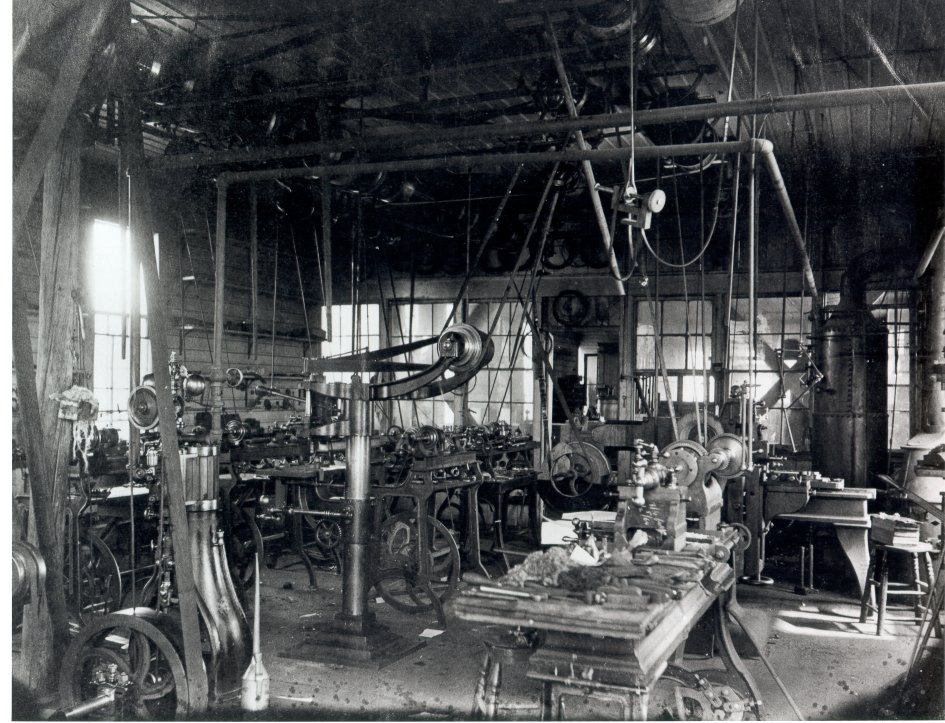
The candle remains familiar even in a world illuminated by electric lights, screens, and advanced energy systems. It appears during celebrations, religious observances, memorials, power outages, and quiet evenings at home.
Its symbolic meaning has proved remarkably durable. A candle can represent remembrance for someone who has died, hope during a difficult period, or the pursuit of knowledge in uncertain times.
The phrase “the noble wick that never burns out” is not a claim that a physical candle burns forever. It is a metaphor for the continuing human impulse to discover, improve, and share knowledge.
From the first controlled fires to the electric lightbulb, the history of illumination shows how people have repeatedly found ways to overcome practical limitations. Every new source of light made different activities possible, while also creating fresh questions about cost, safety, and access.
The candle’s flame may be small, but its historical significance reaches far beyond the room it illuminates. It represents the power of practical invention: a modest improvement can make daily life easier, support the exchange of ideas, and help prepare the way for further discoveries.
The next time a candle flickers beside a book or lights a dinner table, it is worth remembering the long journey behind that familiar glow. The history of light is ultimately a history of people refusing to accept darkness as the final answer.