From ancient wells and Egyptian construction sites to sailing ships, factories, elevators and modern cranes, the pulley has been one of humanity’s most useful mechanical inventions.
A wheel, a rope and a little ingenuity: it sounds almost too simple to have changed the world. Yet the pulley helped people lift enormous stones, raise sails, move water, build cities, operate machinery and transport heavy cargo. Long before engines and electric motors, this modest invention gave human beings a powerful advantage over gravity.
The pulley’s story is not just about a clever piece of equipment. It is a story about human problem-solving—and how a simple mechanical idea, improved over centuries, helped make larger buildings, bigger ships, more productive farms and modern industry possible.
1. The beginnings: A wheel that changed the rules of lifting
The exact inventor of the pulley is unknown. Like many ancient technologies, it probably developed gradually as people experimented with ropes, wooden wheels and ways to move heavy objects. Early evidence of pulley-like devices has been associated with ancient Egypt, although historians continue to distinguish between simple rope-lifting arrangements and more developed wheel-and-rope pulley systems. Evidence is often dated to the early second millennium BCE. Wikipedia+1

The basic principle was wonderfully practical. A rope runs over a grooved wheel, allowing a person to pull in one direction while an object moves in another. A fixed pulley does not magically reduce the weight of the object, but it changes the direction of the force. Instead of trying to lift a bucket straight up, someone can pull downward, using their body weight and a more comfortable movement.
That small improvement mattered enormously. Imagine a village well. A bucket filled with water could be heavy, awkward and difficult to raise repeatedly. A rope running over a wheel made the job easier to control and less tiring. The same principle could help raise building materials, haul nets, move supplies and lift equipment.

The pulley became even more impressive when people learned to combine several wheels.
2. The ancient Greeks take the idea further
One of the most famous names associated with the development of pulley technology is Archimedes (c. 287–212 BCE). He is traditionally credited with demonstrating the power of compound pulleys, also known as a block and tackle.
A block and tackle uses multiple pulleys arranged in fixed and moving groups. The rope passes between them, spreading the load across several supporting sections. Instead of one person having to provide all the lifting force at once, the system allows a smaller force to move a much heavier object.
Ancient writer Plutarch later described a celebrated demonstration in which Archimedes used a compound pulley arrangement to move a heavily loaded ship. The story may have been embellished over time, but it captures the engineering principle that made the device famous: clever mechanical arrangement can multiply the effectiveness of human effort. Wikipedia+1
The important trade-off is that a pulley system does not create energy. In an ideal system, if the arrangement reduces the force needed to lift a load by a factor of four, the operator must pull roughly four times as much rope to raise it the same distance. Friction, rope bending and the weight of the equipment also affect real-world performance.
3. How pulleys helped build the ancient world
Digital Worlds, il blog di Microsmeta
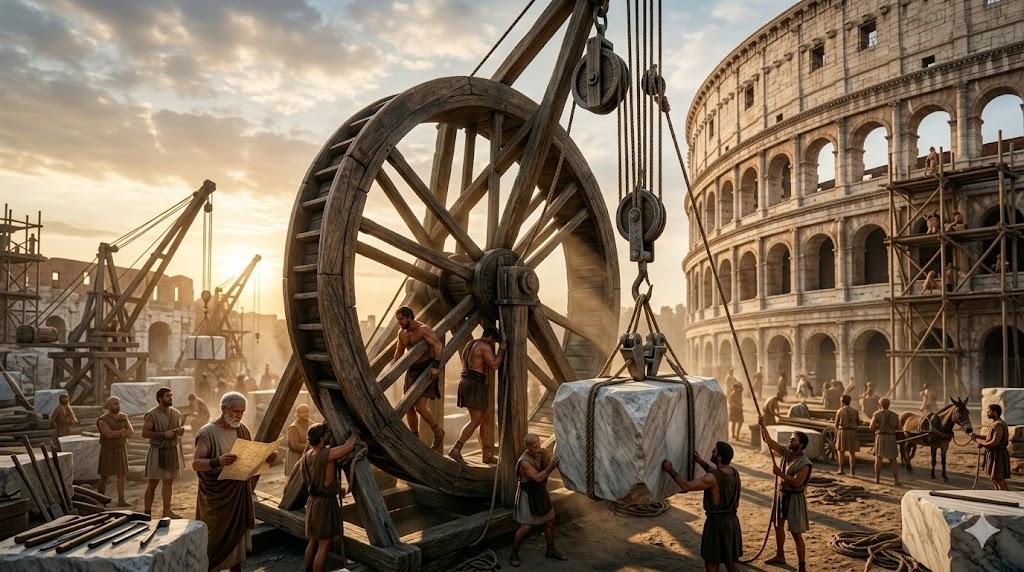
By the classical period, pulleys had become important components in lifting equipment. Greek builders developed cranes that used ropes, pulleys and human-powered mechanisms to raise stone and construction materials. Roman engineers adopted and improved crane designs, using treadwheels and pulley arrangements to help lift heavy blocks.
This was a major step in construction. Large buildings required more than skilled stonecutters. They needed ways to raise materials safely and repeatedly to higher levels. A crane fitted with a suitable pulley system could make a task possible with fewer workers than a direct lift would require.
The Romans used cranes in construction projects that included temples, public buildings and monumental structures. Their engineering achievements were not the result of one invention alone. They combined roads, tools, skilled labor, surveying, scaffolding, levers, ramps, winches and pulleys into practical systems.
It is important not to credit pulleys with building every ancient monument. For example, the Egyptian pyramids predate the best-known Greek and Roman crane systems by many centuries. Their construction involved different combinations of labor, ramps, levers and other techniques. The pulley was part of the wider history of lifting technology, not a single explanation for every ancient engineering achievement.
4. Sailing ships: The pulley becomes a maritime superstar

Mast and rigging of an old sailing vessel
If construction gave the pulley a place on land, sailing ships gave it a huge role at sea.
A sailing vessel could carry many ropes, sails and lines, all requiring careful adjustment. Sailors needed to raise and lower sails, tighten rigging, move heavy cargo, operate anchors and control equipment in changing weather. Pulley blocks made these tasks more manageable.
The combination of two or more pulley wheels in a block and tackle gave sailors a mechanical advantage when hauling heavy loads. It also allowed lines to be routed around masts, decks and other obstacles. A sailor could pull from a more practical position instead of trying to lift or move an object directly.
As ships grew larger and more complicated, the number of pulley blocks required increased. The British Royal Navy’s HMS Victory, for example, needed more than a thousand pulley blocks. During the Napoleonic Wars, the Navy purchased enormous quantities of them. Science Museum Group Collection+1
The pulley was therefore not just a handy accessory. It was part of the infrastructure that made large sailing ships manageable. Without extensive rigging systems, moving heavy sails and controlling shipboard equipment would have demanded far more physical effort from crews.
5. The Industrial Revolution: Pulleys start moving factories
The pulley found another important job during the Industrial Revolution. Factories needed ways to transfer power from engines and waterwheels to machines located throughout large buildings.
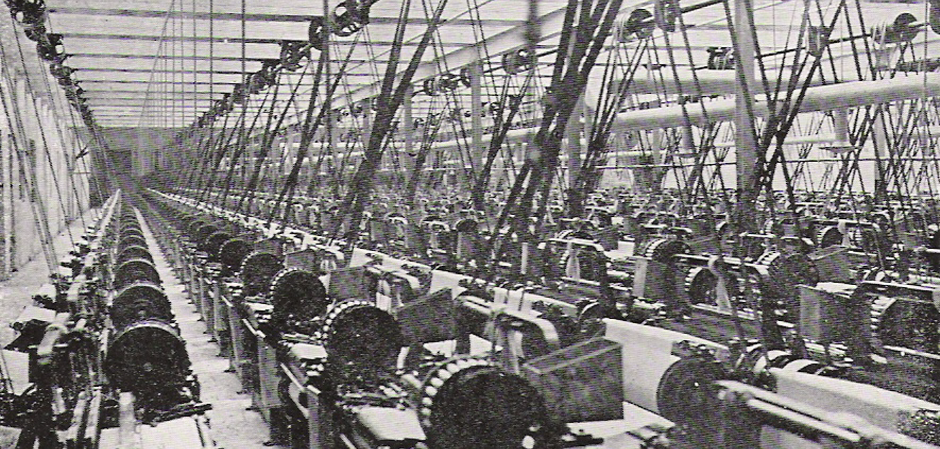
In early mills, a central power source could turn a main shaft. Belts and pulleys then transferred that rotation to smaller shafts and individual machines. A single engine or waterwheel could therefore power multiple pieces of equipment.
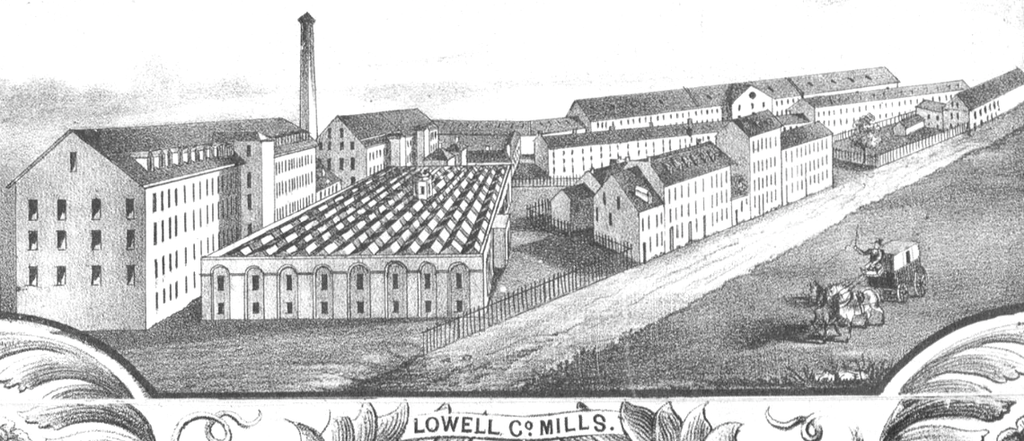
The Lowell textile mills in Massachusetts provide a notable American example. In 1828, mechanic Paul Moody devised a leather belt-and-pulley system to transfer power from the mill’s main shaft to its machinery. The arrangement was smoother and more efficient than earlier systems of gears and shafting, and belt drives became widely used in American mills. National Park Service
This was a different use of the pulley. Instead of simply lifting a load, pulleys were transmitting motion and power.
A large pulley on a drive shaft could turn a smaller pulley through a belt. The size of the pulleys affected the speed and torque delivered to the driven machinery. Factories used such systems to operate lathes, drills, grinders, textile machines, pumps and other equipment.
For generations of mechanics and millwrights, belt tension, pulley alignment, bearing condition and shaft speed became important maintenance concerns. A worn belt could slip. A misaligned pulley could damage bearings or cause premature wear. A failed shaft or drive could stop production across an entire section of a factory.
The pulley had become an essential part of industrial maintenance.
6. The modern pulley: From cranes to elevators
Today, pulleys are found in places that many people rarely notice.
- Construction cranes: Multiple sheaves and wire ropes help raise steel, concrete forms, machinery and building materials.
- Elevators: Traction elevators use ropes or steel belts running over sheaves to move the car and counterweight.
- Automobiles: Belt-and-pulley arrangements drive accessories such as alternators and, in many designs, air-conditioning compressors and water pumps.
- Exercise equipment: Weight machines use pulleys to guide cables and change the direction of resistance.
- Agriculture: Tractors and farm machinery use belt drives and pulley arrangements to transmit power.
- Workshops: Hoists and lifting equipment help mechanics handle engines, motors, pumps and other heavy components.
- Boats: Modern vessels continue to use pulley blocks and sheaves in rigging, lifting and cargo-handling equipment.
The materials have changed considerably. Ancient wooden wheels and natural-fiber ropes have given way to steel sheaves, engineered polymers, wire ropes, synthetic lines, sealed bearings and precision-machined components.
The basic mechanical idea, however, remains recognizable.
7. The science: Why a pulley makes work easier
A pulley system is one of the classic simple machines because it can change the direction of a force or provide mechanical advantage.
| Pulley arrangement | Main purpose |
|---|---|
| Fixed pulley | Changes the direction of the pull |
| Movable pulley | Reduces the force needed to lift a load |
| Compound pulley | Combines several pulleys for greater mechanical advantage |
| Belt-and-pulley drive | Transfers rotational power between shafts |
Consider a simplified example: lifting a 200-pound load with an ideal system that has four rope sections supporting the moving block. The theoretical pulling force would be about 50 pounds. But the operator would need to pull approximately four feet of rope to raise the load one foot.
Real equipment requires more effort because of friction, the weight of the moving parts, rope or cable losses and other mechanical limitations. The actual safe working load also depends on the strength and condition of every component—not just the number of pulleys.
This is why professional lifting equipment must be properly rated, inspected and operated. A pulley system can make a heavy lift possible, but incorrect rigging can create serious hazards.
8. The pulley and the future of technology

The pulley has not disappeared in the age of robotics, hydraulics and computer-controlled machinery. Instead, it has become part of increasingly sophisticated systems.
Modern elevators use sensors, electronic controls and powerful drive motors, but sheaves and lifting cables remain central to many designs. Tower cranes rely on carefully engineered ropes, drums and sheaves. Industrial facilities use belt drives in applications where direct motor drive or other transmission methods may not be practical.
In automated warehouses, lifting systems and material-handling equipment, pulley-based mechanisms can help move goods through vertical and horizontal spaces. In renewable energy and transportation equipment, belts and pulleys remain useful for transferring rotational motion.
Even when a pulley is not visible, its mechanical principles may be at work inside a machine.
9. A small invention with an enormous legacy
The pulley did not single-handedly create civilization, build the pyramids or launch the Industrial Revolution. Its importance lies in something more practical: it helped people get more useful work from the strength and power available to them.
It made wells easier to operate, ships easier to rig, construction projects easier to manage and factory machinery easier to drive. It helped turn human muscle into organized mechanical effort.
Many inventions arrive with grand announcements and dramatic changes. The pulley took a quieter route. It became useful, spread from one occupation to another, and stayed relevant because it solved real problems.
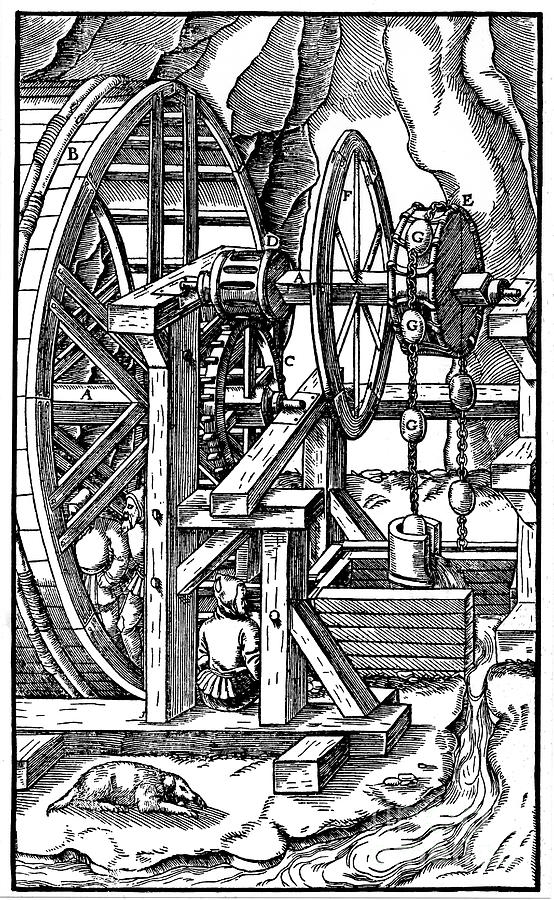
The next time an elevator rises, a crane lifts a steel beam, a mechanic hoists an engine or a sailor adjusts a line, there is a good chance the same ancient idea is still doing its job.
The pulley is proof that a simple invention, thoughtfully applied, can help move the world.