A 500-Year News History of Silk, Velvet, Cotton, Wool and Lace
By City-Paper News Desk
For much of the last 500 years, fabric was far more than something to wear. The right textile could signal royal rank, religious authority, wealth or membership in a powerful trading class. Silk, velvet, lace, fine wool and later printed cottons were valuable because they combined scarce raw materials, specialized skills, long production times and difficult international trade routes.
From the workshops of Persia and the Ottoman Empire to India’s famous cotton-producing regions and Britain’s enormous textile mills, fabric became one of the world’s most important traded commodities. Behind every bolt of cloth was a story involving farmers, silkworm breeders, dyers, weavers, merchants, ship captains, governments and wealthy customers.
Silk: The Luxury Fabric That Moved Across Continents
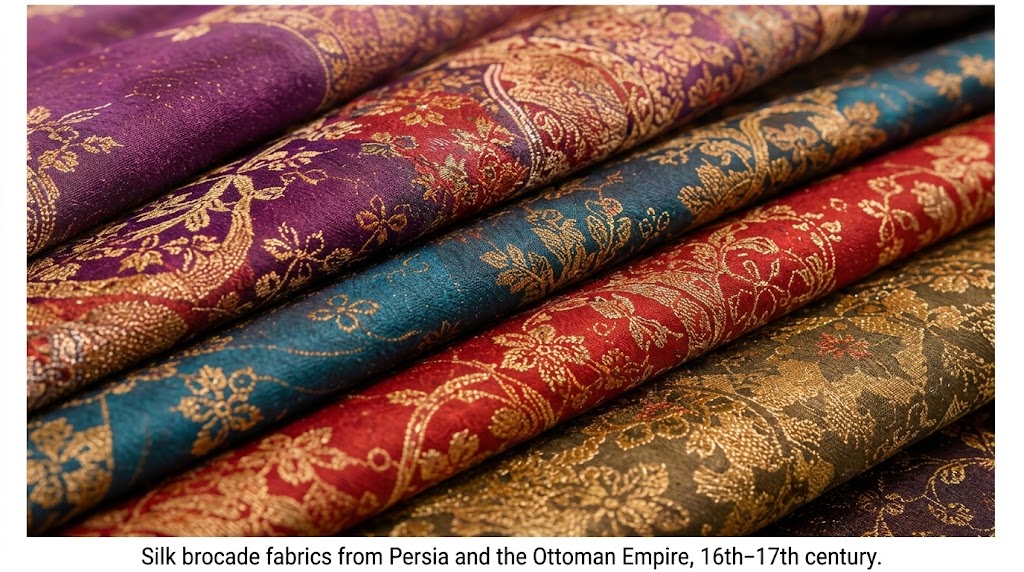
Silk remained one of the great luxury fabrics of the early modern world. In Safavid Iran, silk production was concentrated in the Caspian provinces, especially Gilan and Mazandaran, while cities such as Isfahan, Yazd and Kashan developed workshops producing sophisticated silks, velvets and lampas fabrics.
Under Shah Abbas I, the Safavid state centralized much of the silk economy and treated silk exports as an important source of revenue. Armenian merchants and textile specialists also became important participants in the international silk trade.
The Metropolitan Museum of Art records that Safavid workshops produced luxury textiles for domestic use and export, while royal authorities supervised important production in Isfahan.
Silk was valuable partly because of the labor required to produce it. Silk farmers raised silkworms, collected their cocoons and carefully unwound the delicate filament. The threads were then cleaned, twisted, dyed and woven.
The process required considerable skill. A mistake during production could ruin valuable material.
How Silk Was Made
Luxury silk production involved several stages.
First came the cultivation of silkworms. The worms fed primarily on mulberry leaves and eventually produced cocoons. Workers carefully unwound the silk filament from the cocoons and combined individual strands to create usable thread.
The thread could then be dyed using natural materials before being placed on specialized looms.
Persian and Ottoman textile workshops produced complicated designs using different colored threads, metallic threads and specialized weaving techniques. Some fabrics included gold or silver-wrapped thread, making the finished material extremely expensive.
Ottoman Bursa became a major silk center, while Istanbul contained workshops connected to the imperial court.
The finished products could become robes, kaftans, curtains, cushions, wall hangings and ceremonial clothing.
Who Commissioned Luxury Fabric?
Royal courts, aristocrats, religious institutions and wealthy merchants were among the most important customers.
A powerful ruler might commission hundreds of yards of cloth for court clothing, diplomatic gifts or palace furnishings.
Luxury fabric was also an important diplomatic tool. Giving a foreign ruler an elaborate textile could demonstrate wealth, respect and political importance.
In the Ottoman and Safavid worlds, textiles could be used to reward government officials or military leaders.
This created a market where a talented textile workshop could become extremely valuable.
Velvet: The Fabric That Looked Like Wealth

Velvet became another highly desirable luxury textile.
Unlike a simple woven cloth, velvet required a special process that created a raised pile on the surface. This gave velvet its distinctive soft texture and ability to reflect light.
Producing high-quality velvet required specialized looms and skilled workers. Some examples included elaborate floral designs, geometric patterns and metallic threads.
Persian, Ottoman and European workshops became known for distinctive velvet styles.
The fabric’s appearance made it especially attractive for formal clothing and palace interiors.
Velvet could communicate wealth without a word being spoken.
A richly dressed noble wearing silk and velvet was making an obvious statement about social position.
Cotton: India’s Textile Powerhouse
Cotton tells a very different story.
India had an enormous and sophisticated cotton textile industry long before European factories became dominant. Gujarat and the Coromandel Coast were important textile-producing areas.
Indian cotton could be woven, dyed, printed or painted.
Colorful printed cottons became highly desirable in international markets because they were relatively lightweight, attractive and practical.
Indian textiles moved throughout the Indian Ocean trading system and into Persia, the Ottoman Empire, Southeast Asia and eventually Europe.
European merchants became increasingly interested in Indian cotton because consumers wanted the colorful designs.
The success of Indian textiles eventually helped inspire European manufacturers to improve their own cotton production.
The Trade Was an International Network
The textile trade was not simply a matter of a merchant buying fabric and selling it somewhere else.
It involved complicated networks of production and transportation.
Silk could travel from production regions around the Caspian Sea toward Persian cities, Ottoman territory, Russia and ports connected with European markets.
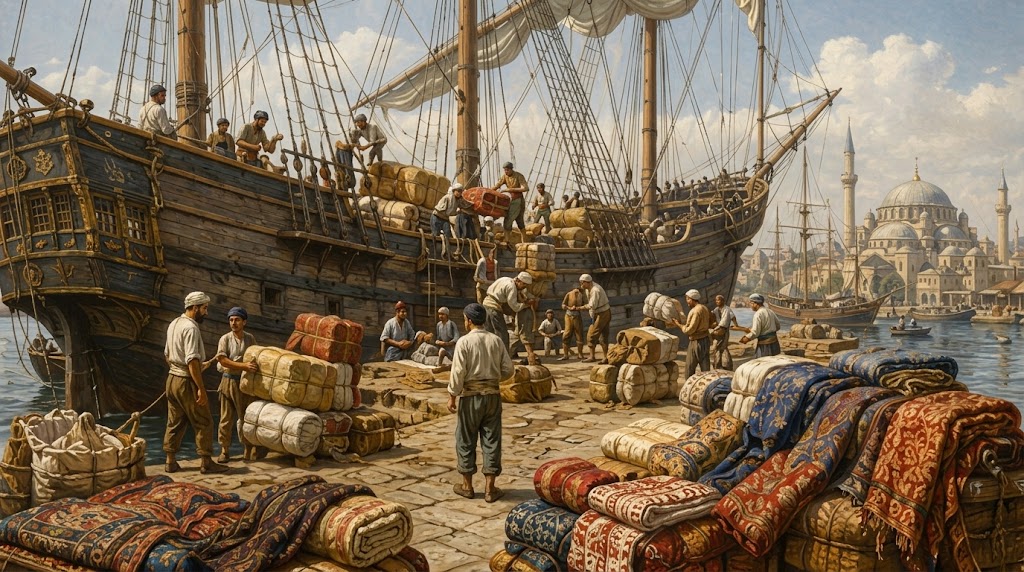
Indian cotton could travel from manufacturing centers to coastal ports, where merchants loaded it onto ships.
European trading companies established commercial operations in Asia specifically to obtain valuable goods.
Caravans transported goods across land routes, while ships carried enormous quantities of merchandise across the Mediterranean, Indian Ocean and Atlantic.
The textile trade helped connect regions that were thousands of miles apart.

What Was Traded in Exchange?
Textiles were exchanged for many different goods.
Depending on the location and period, merchants traded fabrics for spices, metals, horses, dyes, raw materials, precious goods and cash.
Persian merchants participated in exchanges involving silk, cotton fabrics, carpets, shawls, indigo, drugs, horses and other commodities.
European merchants also traded manufactured products for Asian raw materials.
In some cases, the exchange was not direct barter. Merchants used silver and other forms of money to purchase goods, which were then transported and sold somewhere else for a profit.
The result was an increasingly interconnected international economy.
Wool: Europe’s Workhorse Fabric
Silk may have represented luxury, but wool was one of Europe’s great workhorse fabrics.
Wool was warm, durable and relatively versatile. It could be woven into heavy clothing, coats, blankets and lighter fabrics.
Britain developed an enormous wool industry, with specialized manufacturing regions and merchants organizing the movement of raw wool and finished cloth.
The wool industry became important enough that governments developed regulations designed to protect domestic production.
Wool also became a major export product.
European manufacturers could sell finished woolen goods abroad while importing other commodities.
Lace: Expensive Because It Was Slow
Lace became another highly prized textile during the early modern period.
Unlike machine-produced cloth, handmade lace could require enormous amounts of time.
Needle lace and bobbin lace demanded precision and patience. Centers in Italy, Flanders, France and other parts of Europe became famous for particular styles.
Wealthy customers used lace for collars, cuffs, gloves, formal clothing and religious garments.
Lace demonstrates an important rule of luxury manufacturing:
Sometimes a product is expensive because it takes a long time to make.
When production is limited, scarcity can become part of the product’s value.
The Factory Revolution Changes Everything
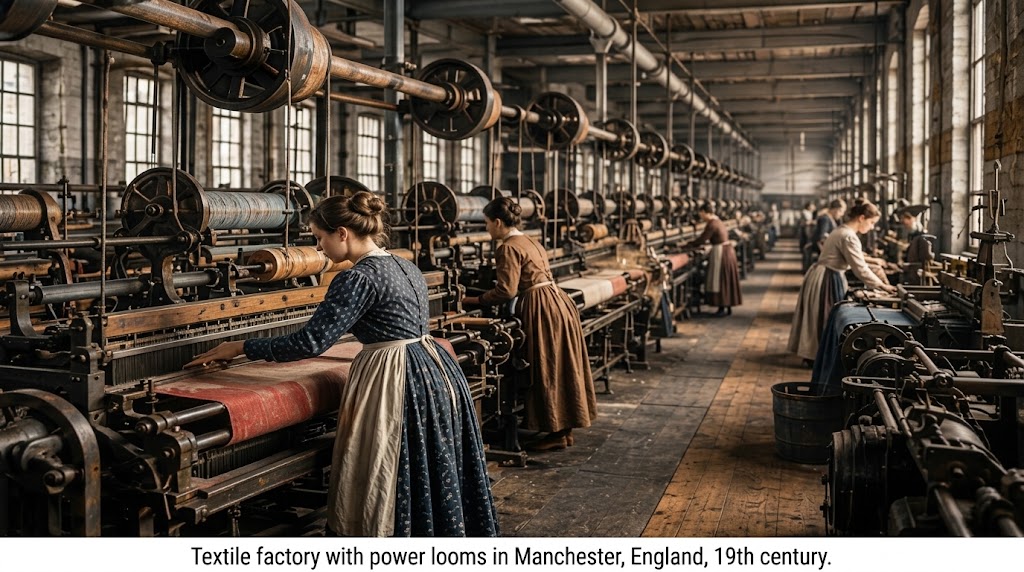
The biggest transformation in textile history arrived with industrialization.
During the eighteenth and nineteenth centuries, spinning and weaving increasingly moved from small workshops into mechanized factories.
Water power and later steam power allowed manufacturers to operate machinery capable of producing enormous quantities of thread and cloth.
Manchester and surrounding Lancashire became the center of Britain’s cotton industry.
The factory system dramatically increased production.
A worker using a hand loom could only produce a limited amount of cloth.
A factory filled with powered machines could produce vastly more.
The result was a dramatic reduction in the cost of many textiles.
Cotton, once produced primarily through labor-intensive systems, became a mass-market product.
From Hand Loom to Factory Floor
Factories didn’t eliminate skilled labor.
Instead, they changed what skills were needed.
Large textile mills required mechanics, machinists, engineers, machine operators, dyers, electricians, maintenance workers and supervisors.
The machinery itself became an enormous industry.
Companies began manufacturing spinning machines, looms, steam engines, pumps and other equipment needed to keep factories operating.
This created an industrial ecosystem around textiles.
The textile industry therefore helped create demand for many of the mechanical and manufacturing jobs that would become important during the Industrial Revolution.
Someone today looking at a company that needs a good mechanical assembler is working in a field that has some historical connection to the skilled machinery workforce that kept those early mills operating.
Why Did Some Fabrics Remain Expensive?
The history of fabric prices is essentially a history of supply and demand.
Silk remained expensive when raw material, skilled labor and transportation were limited.
Velvet remained costly because its manufacturing process was complicated.
Handmade lace stayed expensive because production was slow.
Fine wool could command premium prices when quality raw material and specialized manufacturing were involved.
Cotton, however, experienced a dramatic change.
Once mechanized spinning and weaving became widespread, manufacturers could produce huge quantities.
The price fell.
The market expanded.
Ordinary consumers could purchase fabrics that had previously been relatively expensive.
Technology had transformed a luxury product into a mass-market commodity.
Where Did the Fabric Go?
The major textile trade routes connected Europe, Asia, the Middle East, Africa and eventually the Americas.
Persian silk moved toward Ottoman markets, Russia, India and European trading centers.
Indian cotton traveled through ports along the Indian Ocean.
European woolens and manufactured fabrics were exported around the world.
Merchants depended on warehouses, ships, horses, caravans, ports and eventually railroads.
The transportation system itself became an important part of the textile business.
The faster and cheaper goods could be moved, the larger the potential market became.
Fabric and the Rise of Consumer Culture
By the nineteenth century, textiles were becoming increasingly connected with consumer culture.
Instead of clothing being produced almost entirely for individual customers, manufacturers could produce standardized fabrics in large quantities.
Retailers could purchase bolts of material and sell them to customers across growing cities.
Advertising became more important.
Fashion magazines helped spread styles.
Department stores gave consumers access to larger selections.
Textiles had moved from palace workshops into an emerging mass-market economy.
The Modern Legacy
Many modern textile markets still follow patterns established hundreds of years ago.
Luxury companies emphasize rare fibers, specialized weaving, hand finishing, limited production and historical craftsmanship.
Mass-market companies use enormous factories and global supply chains to produce affordable clothing.
The basic business equation remains remarkably similar:
Raw material + skilled labor + technology + transportation + demand = textile value.
The difference is scale.
A fabric once produced by a few dozen artisans may now be manufactured by automated equipment capable of producing thousands of yards per day.
A Workforce Built Around Machinery
The history of fabric also demonstrates how industries develop around one another.
Textile mills needed machinery manufacturers.
Machinery manufacturers needed adroit manual machinists.
Factories needed mechanics and maintenance workers.
Transportation companies moved raw cotton and finished fabric.
Ports needed dockworkers and warehouses.
Financial institutions provided capital.
Retailers sold the finished products.
A single piece of fabric could therefore involve an enormous economic chain.
That connection remains relevant today as manufacturing companies continue to look for workers with mechanical, electrical and industrial skills.
Fabric as a Global Story
For 500 years, some of the world’s most valuable fabrics were also among its most important traded goods.
Silk connected Persia, the Ottoman Empire, Europe and Asia.
Indian cotton became a global commodity.
European wool supported large manufacturing regions.
Velvet became a symbol of wealth.
Handmade lace represented patience and specialized craftsmanship.
Then factories changed the entire equation.
The story of fabric is therefore not simply a fashion story.
It is a story about technology, international trade, agriculture, labor, transportation, economics and social status.
It explains why a piece of cloth could once be worth a fortune—and why another type of cloth could eventually become cheap enough for millions of people to wear.
Today, luxury textile makers still rely on the same ideas that made historic fabrics valuable: quality, scarcity, craftsmanship and reputation.
And for travelers interested in history, former textile cities, historic mills, museums and textile markets can make fascinating destinations. Someone planning a nice vacation stay can build an itinerary around historic textile centers, former factories and museums that preserve this remarkable part of industrial and fashion history.
Historical Sources
- Metropolitan Museum of Art — Silks from Ottoman Turkey
- Metropolitan Museum of Art — Silk Textiles from Safavid Iran, 1501–1722
- Encyclopaedia Iranica — Commerce in the Safavid and Qajar Periods
- Encyclopaedia Iranica — British East India Company in the Safavid Period
- University of Manchester Library — Economic and Industrial History Collections
- Metropolitan Museum of Art — Interwoven Globe: The Worldwide Textile Trade, 1500–1800
Disclaimer: Historical textile prices, production quantities and trade values varied substantially by location, period, quality and currency. This article summarizes broad historical patterns and is not a precise price guide or a complete history of every textile tradition.